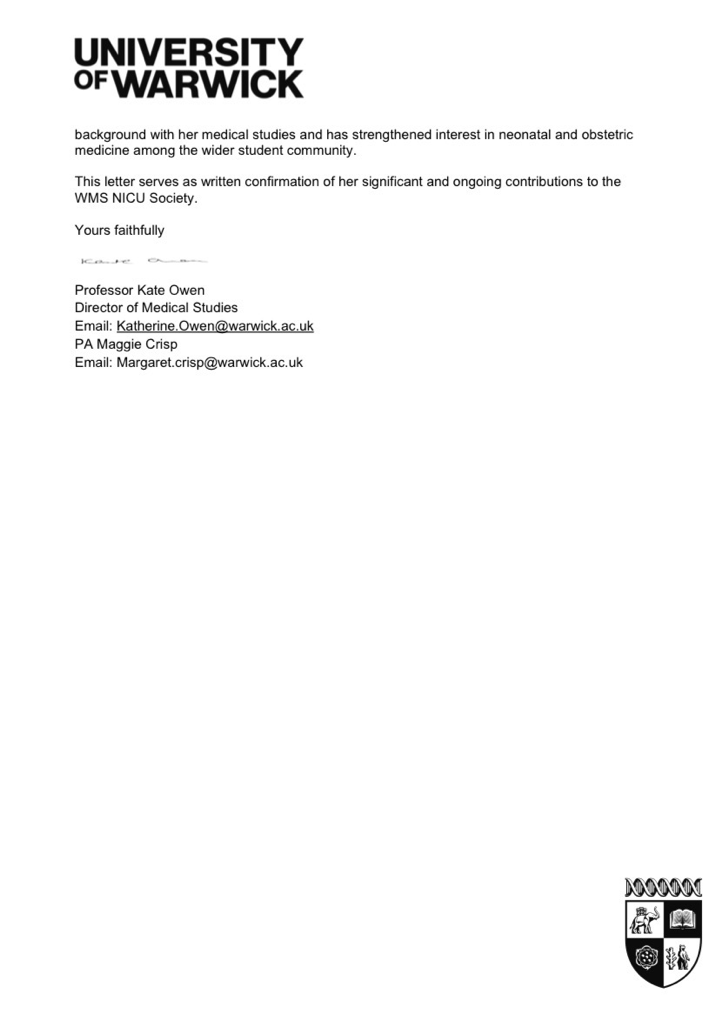
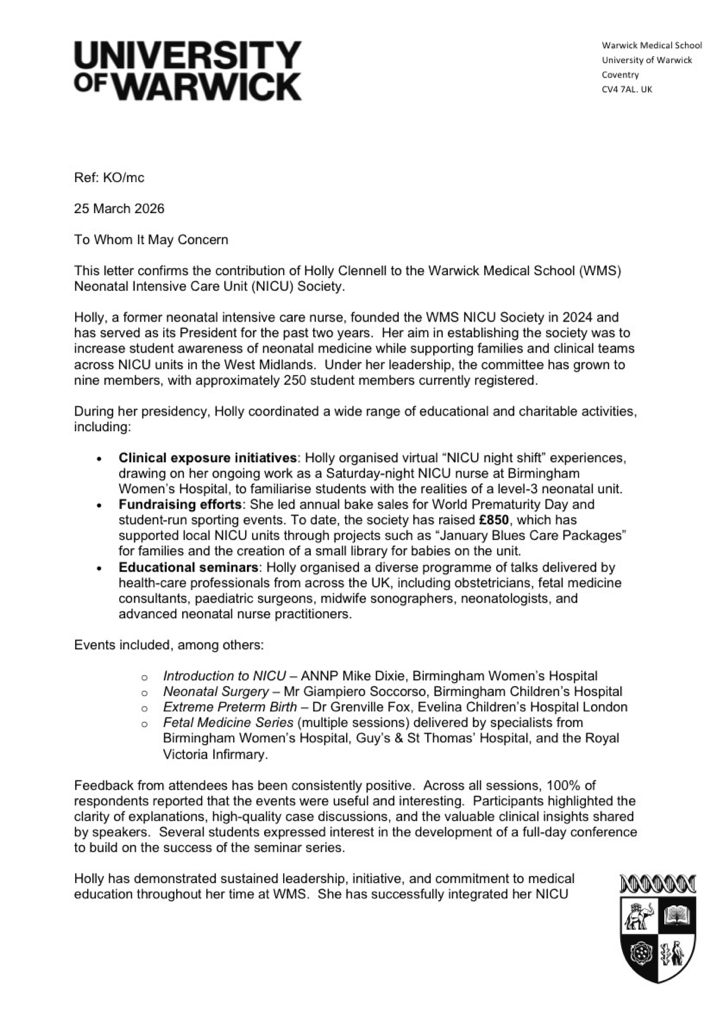
 Appendix 2: Letter of commendation from Warwick Medical School describing the impact of the WMS NICU Society
Holly Clennell, University of Warwick
In this reflective article, I critically examine the development of the WMS NICU Society using the DIEP model, with a focus on interdisciplinary learning and undergraduate speciality awareness. Drawing on my experience as both an accelerated medical student and NICU nurse, I explore why I chose to frame the project around neonatal and perinatal care, particularly focusing on the importance of early exposure to level three NICUs during medical school. Exposure to this area of medicine during undergraduate studies is often limited, yet for many students it may be the only opportunity they have to encounter neonatal intensive care before speciality training. For doctors who do not pursue paediatrics, this exposure may never occur, despite NICU being a highly specialised field distinct from other paediatric subspecialities. The Society offers seminar series, virtual NICU night shifts, and fundraising initiatives in an attempt to address this gap, promote holistic learning and improve understanding of neonatal and fetal medicine. I also evaluate the SDA’s project’s strengths and limitations, including engagement, accessibility, sustainability and the challenge of measuring learning beyond positive feedback. Overall, the project has strengthened my teaching practice, supported my developing professional identity, and reinforced the value of early exposure in helping students recognise NICU as a potential career path.
This paper reflects on my student-derived assessment (SDA) project: the development of the Warwick Medical School Neonatal Intensive Care Unit (WMS NICU) Society and its educational seminar series, which aimed to address a gap in undergraduate exposure to neonatal intensive care and related specialities while promoting interdisciplinary understanding.
A key rationale for establishing the Society was the limited exposure medical students have to level three neonatal intensive care unit (NICU) environments during undergraduate training. In many cases, only opportunity students have to encounter a tertiary NICU before entering speciality training. For doctors who do not choose paediatrics, such exposure may never occur at all. This is important since NICU is a highly specialised field that differs significantly from other paediatric subspecialties in both clinical complexity and the nature of its multidisciplinary working. As a result, students who may thrive in NICU may never realise it is a viable career option if they do not see themselves as suited to paediatrics. The Society was therefore established not only to improve speciality awareness, but also to make a speciality that is often hidden during medical school more visible and accessible.
Alongside being a student on the accelerated medicine programme, I have a background as a neonatal intensive care nurse. Over the past eight years, I have had the privilege of supporting critically unwell neonates and their families during the earliest and often most uncertain stages of life. Through this experience, I developed an appreciation not only for neonatal care, but also for the wider perinatal journey, including antenatal, intrapartum and postnatal health.
Working within NICU highlighted the importance of multidisciplinary collaboration. Neonatologists, obstetricians, nurses, midwives, anaesthetists, psychologists and charities all contribute to care, demonstrating that neonatal outcomes are shaped by a broad professional network. However, undergraduate medical education often presents these disciplines separately, which may limit students’ understanding of how they intersect.
Using Boud et al.’s (1985) DIEP model, this reflection explores the development of the project and considers how it has contributed to interdisciplinary learning as well as my own professional development.
The WMS NICU Society was established in 2024 with the aim of increasing awareness of neonatal intensive care and supporting both students and local NICU communities. As founder and president, I worked with a committee of nine individuals and helped grow the Society to approximately 250 student members.
The project included three main components. First, an educational seminar series was developed, involving healthcare professionals from across the UK, including obstetricians, fetal medicine consultants, midwife sonographers, advanced neonatal nurse practitioners, neonatologists and paediatric surgeons. Topics covered included an introduction to NICU, neonatal surgery, extreme prematurity, fetal medicine, obstetric scan interpretation, multiple pregnancy complications and fetal abnormalities affecting cardiac, neurological and gastrointestinal systems. While this range reflected interdisciplinary input, the session-based format may have limited opportunities to explicitly integrate perspectives across specialities.
Second, experiential learning opportunities were introduced via virtual ‘NICU night shifts’. Drawing on my ongoing work at Birmingham Women’s Hospital, these sessions aimed to provide insight into the diverse population of patients and conditions cared for on a level three neonatal unit. They exposed students to the range and complexity of cases encountered within NICU, although the lack of direct participation may have limited the depth of experiential engagement.
Third, the Society undertook fundraising and community-based initiatives. Activities such as World Prematurity Day bake sales and charity runs raised approximately £850, which supported initiatives including ‘January Blues’ care packages for families and the creation of a hospital baby library. While these initiatives were incredibly meaningful, they may be perceived as separate from the educational aims of the project.
Feedback from participants was very positive, stating improved awareness of NICU terminology, procedures and greater confidence in asking clinically focused questions. Responses also demonstrated satisfaction with all respondents stating sessions were useful and engaging. Students particularly valued case-based teaching, detailed explanations and the opportunity to learn from clinicians with varied experiences. However, such feedback does not necessarily capture the depth or long-term impact of learning.
The NICU Society can be understood as an application of experiential and interdisciplinary learning principles. Kolb’s experiential learning model (Kolb, 1984; Wei et al., 2025) suggests that learning is most effective when grounded in experience. Although students were unable to participate directly in clinical care, the virtual ‘NICU night shifts’ offered a form of vicarious experiential learning by presenting authentic clinical scenarios. However, without active involvement, this learning may remain largely observational.
The use of case-based teaching aligns with Vygotsky’s constructivist theory, which proposes that learners build understanding through contextualised experience (Taylor and Hamdy, 2013; Vygotsky et al., 1980: 79–91). Feedback referencing ‘case discussions’ and ‘real-life examples’ suggests that this approach supported engagement and understanding by participants feeling more confident in applying theory to practical scenarios. The emphasis on early exposure to level three NICUs is especially important in this context. Since NICU is usually encountered only within paediatric training, undergraduate medical school may be the only stage at which many students can see the speciality in practice. This makes early contact not simply beneficial on an educational standpoint, but potentially career-shaping. Some students may never consider NICU as they believe the field of paediatrics in general is not well-suited to them, even though the nature of neonatal intensive care may actually align well with their strengths with it being such a niche area of medicine.
My background in NICU nursing influenced the development of the project. Working closely with families highlighted the importance of holistic, family-centred care. Initiatives such as the Purple Butterfly Project (Discenza, 2024) and Beads of Courage (2023), alongside organisations such as Noah’s Star (Cooper and Holder, 2019), emphasise the role of emotional and social support within clinical care. These experiences reinforced the idea that neonatal care extends beyond biomedical treatment and ensuring an interdisciplinary approach at all times is essential. This perspective informed the inclusion of topics such as kangaroo care and family-integrated care (Yarlagadda et al., 2025), which have been shown to improve both clinical and emotional outcomes. However, it is possible that these interdisciplinary links were not always made explicit enough for students to fully appreciate their significance.
The project also contributed to my developing professional identity. Exposure to fetal medicine through both teaching sessions and research – including creating a systematic review on myelomeningocele fetal surgical repair – strengthened my interest in obstetrics. The Society therefore provided an opportunity to explore links between my previous experience and future career interests, although this may also have influenced the direction of the project. Regarding the teaching seminars delivered, it is important to consider that my personal connection to NICU may have introduced bias. My interest in the speciality, specifically fetal medicine, may have influenced topic selection and delivery, potentially shaping the perspectives presented. This highlights a challenge within reflective practice: maintaining a balance between personal motivation and critical awareness. To address this, I critically reviewed teaching content following each session and ensured each session prioritised both the most common presentations and the most severe or high-risk diagnoses that are important not to miss, ensuring clinical relevancy throughout. Society members were also asked to complete feedback forms following each seminar with the final question asking what they would like to see in the next instalment. Completion of the ‘Learning to Teach’ programme offered by WMS supported the development of my teaching approach through exposure to educational theory, feedback and group dynamics. Completing over 100 hours of peer teaching reinforced the importance of adapting teaching to different levels of prior knowledge, particularly in interdisciplinary settings. Collectively, these strategies resulted in more structured and clinically relevant teaching seminars with content balancing core neonatal presentations with critical high-risk conditions, reduced the influence of my personal interest in fetal medicine on topic selection and allowed the programme to evolve in direct response to student feedback; thereby improving engagement, confidence and applicability to clinical practice.
One of the main strengths of the project was its ability to engage students. The growth in membership and positive feedback suggest that there is interest in clinically relevant, interdisciplinary learning, consistent with literature highlighting the value of applied teaching approaches (Taylor and Hamdy, 2013; Vygotsky et al., 1980: 79–91). Educational effectiveness was evident via the inclusion of active recall within each session, with students being asked topic-specific questions following part of the teaching session and then challenged to apply said knowledge to various clinical scenarios. This encouraged both knowledge retention, application and clinical reasoning. Combining theoretical knowledge with practical insight via educational seminars, experiential elements and fundraising initiatives allowed for both cognitive and emotional aspects of learning, aligning with expectations of holistic care. Feedback for these sessions and the response from the care packages that were able to be created from fundraising was all extremely positive and resulted in a letter of commendation from Warwick Medical School describing the impact of the WMS NICU Society (Appendix 2). A further strength was the project’s potential to broaden speciality awareness. By introducing students to level three NICU early, the Society helped address an educational gap that may otherwise leave many students unaware of the speciality’s scope and appeal.
Regarding limitations, accessibility was a significant factor as not all students were able to attend live sessions due to course placement commitments. This raises questions about equity and suggests a need for more flexible learning formats. This was partially mitigated by ensuring the sessions were delivered virtually and recorded wherever possible.
Sustainability is another consideration. As a student-led initiative, the continuation of the Society depends on future student involvement and leadership. Without clear succession planning or institutional support, maintaining the project may be challenging .
Personal bias also needs to be acknowledged. While enthusiasm for NICU supported the development of the project, it may have limited the inclusion of alternative perspectives. Recognising this is important when aiming to support balanced interdisciplinary learning and ensuring the Society members are consistently asked what they would like exposure to is key.
This reflection has identified several areas for future development. Expanding the seminar series into a full-day conference may allow for more comprehensive coverage and better integration of different specialities. Encouraging all undergraduate medical students to have a placement experiencing a level three NICU and ensuring this sub-speciality is advertised throughout curriculums is pivotal. Future iterations of the project should make the significance of level three NICU exposure even more explicit. This could include career-focused sessions on the varied pathways into NICU and testimonies from clinicians who entered the speciality through different routes. Such additions may help students realise that NICU is not only part of the paediatric training pathway, but also a field that may appeal to those who would not otherwise consider paediatrics. Likewise, increasing opportunities for student involvement in neonatal and fetal medicine research may encourage deeper engagement with evidence-based practice. Specifically regarding the WMS NICU Society, implementing clear succession planning, including mentoring future committee members, can help support the sustainability of the Society. Finally, continuing to develop my teaching practice is vital to ensure sessions are pedagogically robust, affordable to varying levels of prior knowledge and effectively translate complex concepts into clinically applicable understanding; particularly in ensuring that sessions are inclusive, evidence-based and that interdisciplinary connections are made more explicit. Incorporating formal evaluation methods may also provide a clearer understanding of learning outcomes.
The WMS NICU Society represents an attempt to support interdisciplinary learning by bringing together clinical experience and medical education in the field of NICUs. Using the DIEP model has provided a framework to reflect on both the strengths and limitations of this project, particularly in relation to accessibility, sustainability and potential bias. It also highlights that interdisciplinarity requires more than the inclusion of multiple specialities and instead depends on how effectively connections between them are made.
There are also broader implications for workforce development. Limited exposure to level three NICUs during undergraduate training may contribute to fewer doctors considering it as a career. Given that NICU is part of paediatric training but differs significantly from other sub-specialities, those who do not pursue paediatrics may never experience it, despite potentially being well-suited to its unique clinical environment. Early exposure is therefore important not only for speciality awareness, but also for ensuring that capable and interested students do not overlook NICU simply because they have not seen it.
Overall, this project has contributed to my development as both a learner and an educator, and has encouraged me to reflect more critically on how educational initiatives can be designed and evaluated. It has also reinforced my interest in obstetrics and neonatology, while highlighting the importance of continuing to reflect on and adapt my approach to teaching and learning.
Keywords: Neonatal Intensive Care Unit (NICU), Interdisciplinary Learning, Medical Education, Medical Speciality Awareness, Undergraduate Exposure of NICU, Medical Student Placements,
Medical School Curriculum, DIEP Model of Reflection
Constructivist theory A theory of learning that states that learners build their own understanding through active engagement and contextual experiences rather than passive instruction.
DIEP Model A structured reflection framework consisting of four stages: Describe, Interpret, Evaluate, Plan. It encourages critical engagement by moving beyond description, toward analysis and application.
Experiential learning model A learning theory emphasising the importance of experience, reflection, conceptualisation and experimentation in developing understanding and professional competence.
Family-integrated care An approach to neonatal care that involves parents as active participants in their baby’s treatment, promoting bonding and improved clinical outcomes.
Interdisciplinary learning An educational approach that integrates knowledge and perspectives from multiple professional fields (e.g., neonatology, obstetrics, nursing, midwifery, clinical psychology) to enhance collaborative understanding and patient care.
Intrapartum The period of care provided to mother and fetus during labour and delivery.
Kangaroo care A method of holding a newborn against a parent’s bare chest, enabling direct skin-to-skin contact to aid in temperature regulation, stabilising heart rate and reducing pain in the newborn as well as reducing parental anxiety, reducing risk of postnatal depression, increasing confidence and improving milk production for the parent.
Level three NICU A tertiary neonatal intensive care unit that provides the highest level of specialist care for critically ill or extremely premature neonates who often require ventilation, surgery or specialist input.
Myelomeningocele fetal surgical repair A specialised surgery performed on a fetus in utero, usually between 19-26weeks gestation, to close an open spina bifida defect whilst the fetus is still in the womb.
Pedagogically robust Educational methods used in teaching to ensure content is effective for understanding, engagement and knowledge retention
Speciality awareness Understanding the scope, skills and career pathways within a medical speciality, critical for informed career decisions and adequate exposure in undergraduate education.
Boud, D., R. Keogh and D. Walker (1985), Reflection: Turning experience into learning, London: Kogan Page
Beads of Courage UK (2023), ‘Our programmes’, available at https://www.beadsofcourageuk.org/our-programmes, accessed: 6 April 2026
Cooper, H. and G. Holder (2019), ‘Noah’s star: A volunteer sibling support service to facilitate family time’, Infant, 15 (1), available at https://www.infantjournal.co.uk/journal_article.html?id=7061, accessed: 6 April 2026
Discenza, D. (2024), ‘A purple butterfly that conveys everything simply and sensitively in the NICU’, Neonatal Network, 43 (4), 251–55
Kolb, D. A. (1984), Experiential Learning: Experience as the source of learning and development, Englewood Cliffs, NJ: Prentice Hall, available at http://academic.regis.edu/ed205/Kolb.pdf
Taylor, D. C. M. and H. Hamdy (2013), ‘Adult learning theories: Implications for learning and teaching in medical education: AMEE Guide No. 83’, Medical Teacher, 35 (11), 1561–72
Vygotsky, L.S., M. Cole, V. John-Steiner, S. Scribner and E. Souberman (1980), Mind in Society: The development of higher psychological processes, Massachusetts: Harvard University Press
Wei, H., N. Sheng, X. Wang and Z. Zhang (2025), ‘Enhancing practical skills in medical education: Evaluating the efficacy of virtual simulation teaching through Kolb’s experiential learning model’, Advances in Medical Education and Practice, 16, 1129–1139
Yarlagadda, H., J. Sandbulte and E. Downs (2025), ‘Challenges and enhancement of health: A dual impact of kangaroo care on parents and infants—systematic review’, mHealth, 11, 36
Table 1: Summarising the WMS NICU Society events and participant feedback
Event |
Feedback / Details |
Introduction to NICU with ANNP Mike Dixie, Birmingham Women’s Hospital |
Teaching seminars organised and hosted by WMS NICU Society. Guest speakers were from a variety of different disciplines including: neonatologists, obstetricians, fetal medicine consultants, paediatric surgeons, nurses, midwives and sonographers. The first year of events focused on an introductory series to NICU as a potential speciality before the second year focused on delivering a teaching series focused on fetal medicine Feedback: ‘I loved hearing about the niche cases experienced within this field and learning about the pathophysiology’ ‘Very interesting hearing the different types of neonatal surgery and watching videos with commentary explaining the procedures’ ‘Really thorough informative talk, great amount of detail with lots of examples all explained very clearly, went into detail regarding ultrasound scans and how to detect each abnormality’ ‘Great use of cases to explain complicated concepts’ ‘Loved the anecdotes from personal experience’ |
Neonatal Surgery with Paediatric Surgeon Mr Giampiero Soccorso, Birmingham Children’s Hospital | |
Extreme Preterm Birth with Neonatal Consultant Dr Grenville Fox, Evelina Children’s Hospital London | |
Follow Along NICU Night Shifts with Neonatal Nurse & Medical Student Holly Clennell, Birmingham Women’s Hospital & Warwick Medical School | |
Experiences in Fetal Medicine with Fetal Medicine Consultant Mr Leo Gurney, Birmingham Women’s Hospital | |
Obstetric Scan Interpretations with Midwife Sonographer Rebecca Aston, Birmingham Women’s Hospital | |
Multiple Pregnancy Complications with Fetal Medicine Consultant Ms Srividhya Sankaran, Guys & St Thomas’ Hospital London | |
Fetal Cardiac, Neuro & GI Abnormalities with Subspeciality Trainee in Maternal-Fetal Medicine Dr Emily Frier, Royal Victoria Infirmary Newcastle-upon-Tyne | |
Fundraising |
Raising awareness of annual World Prematurity Day via bake sales and sporting events to fundraise for local NICU units |
NICU Care Packages |
Fundraised money utilised to purchase items to go into care packages for families and to create a ‘hospital library’ for the families of babies on the local NICUs |
Appendix 2: Letter of commendation from Warwick Medical School describing the impact of the WMS NICU SocietyFigure 1: Letter of commendation from Warwick Medical School outlining the impact of the WMS NICU Society
To cite this paper please use the following details: Clennell, H. (2026), 'Establishing the WMS NICU Society: A Critical Reflection Using the DIEP Model on Interdisciplinary Learning, Medical Education and Enhancing Speciality Awareness', Reinvention: an International Journal of Undergraduate Research, Volume 19, Issue 1, https://reinventionjournal.org/index.php/reinvention/article/view/2372. Date accessed [insert date]. If you cite this article or use it in any teaching or other related activities, please let us know by emailing us at Reinventionjournal@warwick.ac.uk.
https://doi.org/10.31273/reinvention.v19i1.2372, ISSN 1755-7429 © 2026, contact reinventionjournal@warwick.ac.uk. Published by the Institute for Advanced Teaching and Learning, University of Warwick. This is an open access article under the CC-BY licence (https://creativecommons.org/licenses/by/4.0/)