Monisha Pandhi, University of Warwick
Countries such as the UK face a surging demand for care services in line with rising ageing populations. Yet the sector faces high turnover rates and many carers – the majority of whom work in domiciliary care and have immigrated to the UK on the Skilled Worker Visa – face mental and physical fatigue. This paper examines the extent of the role of the UK’s current immigration system in the context of the lives of migrant domiciliary care workers. Using semi-structured interviews, the experiences of migrant South Asian domiciliary care workers were compared with those workers employed in care homes. Using thematic analysis, themes relating to employer–worker relationships, experiences within the UK’s immigration system and working routines were explored to uncover the intersectional inequalities the carers faced. The results show that employers contribute to the reproduction of the inequalities of gender and ethnicity perpetuated by the exploitative nature of the UK’s regulatory and immigration frameworks. These findings point to the root behind the current shortage seen within the industry.
Key words: Institutional exploitation in domiciliary care, ageing population, migrant inequalities, layered vulnerabilities from visa–employer dependency
It is estimated that the UK will need 540,000 new social care posts by 2040, as the number of elderly people is expected to grow by a third (Skills For Care, 2025: 6). Yet, the Office for National Statistics estimates that 335,000 care workers leave the industry each year (Fenton et al., 2025: 55). This high turnover rate is a major problem in countries such as the UK because it undermines the well-being of ageing populations and costs the UK £47.7bn annually (Maheshwari et al., 2025, cited in Carers Trust, 2026).
When assessing the UK’s paid care sector in more depth, it is found to be overrepresented by women, with 24 per cent being migrants seeking higher pay (Migration Advisory Committee, 2022: 7–32). Additionally, 46 per cent of the workforce consists of domiciliary carers who provide door-to-door services (Skills For Care, 2025). These workers arrive in the UK on the Skilled Worker Visa where agencies sponsor them to live and work in the country. With UK immigration legislation becoming more stringent, extensive evidence shows many of these workers face risks in securing better earning potentials and living in the UK, making them more susceptible to exploitation.
A much-debated question is whether the exploitation of migrant domiciliary carers is facilitated by their employers or regulatory bodies. This study investigates this question by exploring inequalities through Crenshaw’s intersectional lens (2021) in interviews with South Asian carers in London. While employers play a role in reproducing the intersectional inequalities faced, the exploitation of migrant domiciliary care workers is fundamentally perpetuated by regulatory and immigration frameworks. Few studies have thoroughly investigated this matter beyond the role of employers and those that do often fail to account for recent regulatory changes.
The paper is organised in the following way: Section 2 is a literature review assessing scholarly debates on migration systems, institutional exploitation and intersectional inequalities in the context of the UK’s growing ageing population. Section 3 describes the qualitative methodology used, acknowledging the reasoning behind implementation and limitations. Section 4 discusses the results from the semi-structured interviews, drawing comparisons between the different participant groups. Finally, Section 5 will outline the need to implement higher pay and greater government support to tackle the nationwide carer shortage.
This study places research on intersectional inequality by Black et al. (2005) and Bastia (2013) within the context of visa eligibility changes introduced through the UK’s new migration laws.
Migration refers to the movement of individuals from one place to another for various reasons, for example improving their earning potential, increasing social freedom or to escape from conflict (Bastia, 2013; Black et al., 2005). ‘Intersectional inequalities’ is a term coined by Crenshaw (2021), and is central to this study because it shows how overlapping conditions such as gender, ethnicity, age and class combine to exacerbate vulnerability. Crenshaw’s concept of intersectional inequalities becomes important in this context because it helps to identify the costs and benefits of migration for individuals. Black et al. (2005) note that these benefits and costs are unequally distributed, whereby the initial distribution of income and an individual’s socio-economic status play key factors in determining whether a migrant will experience vulnerabilities or not. Especially, links with recruiters become essential to secure safe employment, otherwise migrants ‘have problems finding living arrangements’, making them more vulnerable to ‘intimidation under non-payment of wages, isolation and loneliness’ (Black et al., 2005: 13). Bastia highlights that highly restrictive and selective policy frameworks result in migrants having limited access to resources (Bastia, 2013: 64–65). Taken together, these studies suggest that vulnerability is not an inherent feature of migration itself but is produced through the interaction of legal, economic and social barriers.
In the context of the UK, migration policy has changed substantially in response to Brexit and the COVID-19 pandemic. Restrictions on lower-skilled migration reduced the supply of paid adult carers and contributed to staffing shortages across the care sector (Hussein et al., 2024; Portes and Springford, 2023). The introduction of a Skilled Work Visa imposed fees on migrants and demanded their skillset to be of a high quality (Portes and Springford, 2023). Despite acknowledging the shortfalls in migration for work, Portes and Springford(2023) fail to recognise inequalities faced by migrants of differing occupations within the UK. Hussein et al. (2024) found through interviews with Zimbabwean and European migrant carers that changes to the UK’s migration system combined with the limited interaction with wider UK society significantly worsened their financial and mental well-being. While this overlooks a traditional economic approach, these scholars generalise their findings to all types of care workers and fail to account for the difficulty in obtaining working visas, especially as the UK has recently constrained visa eligibility.
To assess this phenomenon in a more recent context, this review examines how such inequalities manifest specifically within the UK care sector. The remaining literature therefore centres on visa–employer dependencies, the regulatory system and everyday workplace exploitation.
A growing body of work highlights how visa rules that link a migrant’s legal status to a specific sponsoring employer create a distinct form of dependency that amplifies migrants’ vulnerability. Skills For Care’s most recent analysis of the adult social care workforce shows that migrant recruitment has become highly concentrated among Indian, Nigerian and Zimbabwean nationalities, who make up a third of all non-British nationals in the sector (Fenton et al., 2025: 83). The same report found that over 470 sponsor licences in the care sector were revoked in response to concerns of abuse and exploitation, affecting over 39,000 workers (Fenton et al., 2025: 160). Thiemann et al. (2024) conceptualise this as a form of ‘tied’ or ‘hyper precarious’ status, which results in short duration visas, high recruitment debts and complex oversight by bodies such as DEFRA, making it difficult for workers to leave exploitative employment. Scholars such as Bales and Mayblin (2018) argue that this is a new form of slavery in which debt-bondage keeps individuals in vulnerable job roles, thereby exacerbating power imbalances between employers and workers. However, the role of gender and racial inequalities is explored only minimally by such scholars, despite ethnic minorities being among the groups most likely to experience these exploitative relationships.
Literature surrounding the UK’s visa eligibility system is abundant, yet there is very little information on how changing regulations affect migrants working in the paid care sector. Evidence suggests that the Health and Care Worker visa route became increasingly restrictive between 2021 and 2024 with further tightening anticipated (Fenton et al., 2025). Comparative research by Charlesworth and Malone (2024) indicates that the UK offers weaker protection for migrant workers than countries such as Australia and the Netherlands, and raises concerns about the strength of the regulatory system. The research conducted in this paper aims to correlate the current and changing structure of the UK regulatory system with the decrease in migrant workers coming to the UK potentially providing an insight into why a shortage of paid carers exists. Singleton and Fry (2015) note that the UK’s carer allowance system must recognise how much carers contribute to society, with regulatory changes affecting their citizenship status and consequently impacting their choice of employment, control over earnings and job security. However, there remains a lack of up-to-date, sector-specific analysis that captures how evolving legislation interacts with lived experiences of migrant women of different ages working in domiciliary care.
Research on inequalities within care work has traditionally focused on informal caregiving, and has often overlooked the conditions of paid migrant workers. Heitmuller and Inglis (2007) note that discrimination faced by carers, those predominantly being women, represents an opportunity cost that hinders their participation in the labour market. Dixon and Round (2019) build on this by explaining that many individuals rely on informal care from friends and family, which can affect the health of the carer. More recent work suggests that both health outcomes and the likelihood of becoming an unpaid carer can also be influenced by socio-economic insecurity and structural barriers, which are more common among ethnic minority women (Armstrong et al., 2025).
While these scholars only focus on unpaid carers, a similar principle applies to paid care workers. Empirical findings from Thiemann et al. (2024) identify multiple instances of severe exploitation and abuse that paid carers face. In all the cases Thiemann et al. (2024) explore, work was tied to tied to debt-financed migration pathways, with some workers borrowing between £2,000 and £40,000 to cover the costs of recruitment, visa and travel (Thiemann et al., 2024: 20). The authors also note the Home Office makes an 80 per cent profit from charging fees to these workers and proceeds to give them no access to support if their visas are lost (Thiemann et al., 2024: 43–44). A recent House of Common’s report also criticises the Home Office for tightening sponsor rules rather than addressing the structural conditions allowing the exploitation of migrant care workers (House of Commons, 2025: 21).
In summary, this study expands the literature by using qualitative insights that capture how more recent legislative changes have affected the lived experiences of ethnic migrant women of different ages in the UK’s paid carer industry. It seeks to examine how carers face intersectional inequalities beyond employer misconduct, and subsequently proposes solutions the Home Office could implement to mitigate these.
This study uses a qualitative research design, using semi-structured interviews to explore the lived experiences of South Asian female care workers in London. South Asian women were chosen because this group makes up 17 per cent of the domiciliary care workforce (Fenton et al., 2025) and was the most accessible for the researcher to recruit, given her positionality as an individual from a South Asian family.
Semi-structured interviews (Haenssgen, 2019: 3) were useful for thoroughly exploring topics such as transparency, emotional labour and the impact of immigration policy (see Table 1 in Appendix A). Additionally, the semi-structured interviews enabled carers to self-describe their subjective perspectives and lived experiences, which helped to reduce hierarchical ‘masculine’ dynamics (Oakley, 2013: 31–44; Oakley, 2020). This approach provides a more nuanced means of exploring Crenshaw’s conceptualisation of intersectional inequalities within care work. Having subjective experiences that are rich in detail allows a comprehensive analysis of the extent to which gender and ethnicity can affect the experiences of the carers.
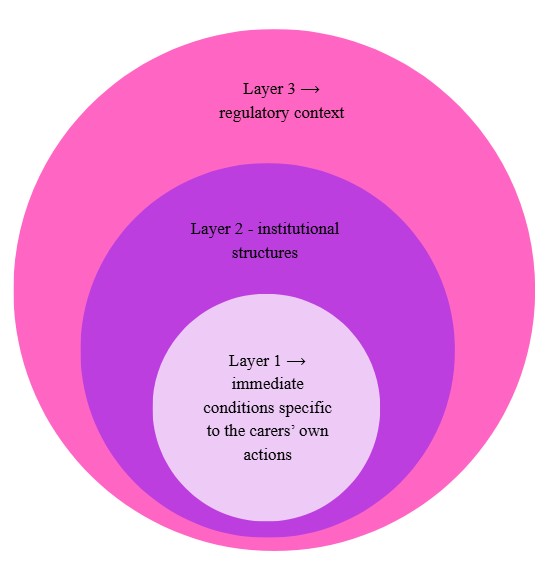
Based on the literature and Oakley’s understanding of nuanced inequalities, the research design centres interview questions around a concentric model. This approach moves from the carers’ own motivations outwards towards the role of institutional structures and the wider regulatory context. Structuring the research design around this model is necessary to understand the layered forms of vulnerability that exist within the UK’s care sector.
Figure 1: Concentric visual of layered vulnerabilities based on the literature
Initially, the aim was to interview domiciliary carers of varying ages working privately and those working for the NHS. These carers were to be South Asian women and were contacted via email. However, the NHS does not directly hire domiciliary care workers and instead subcontracts carers from private agencies through local councils (NHS, 2024). Consequently, the final sample focused on comparing private-sector domiciliary workers with care home workers.
Over the course of a month, three participants agreed to take part out of a total of six who were contacted. Purposive snowball sampling was used to obtain contact details of the carers. This was useful for accessing existing social networks within a hard-to-reach population (Noy, 2008), enabling me to build rapport.
Inductive thematic analysis was used to analyse the interview transcripts in line with Braun and Clarke’s (2006) methodology. The interview transcripts were initially codified by interview question, which allowed for a comparative analysis of the different working styles and immigration experiences across different types of carers. Codes were refined into broader themes such as transparency, emotional labour, and so on (see Table 1 in Appendix A). Analysing this case with thematic analysis is a robust methodology in line with allowing marginalised populations to present their views fully (Riger and Sigurvinsdottir, 2018).
Interviews were conducted online and lasted between 20 and 45 minutes. Prior to the interview, carers were sent a participation information leaflet in English, Gujarati or Hindi outlining the aims, objectives, scopes and potential risks of the study. At the beginning of each interview, an oral consent form was obtained, with carers confirming that they fully understood their participation was voluntary and that they could withdraw within a specified period. Ethical procedures were strictly followed as the participants were a vulnerable population. Ethical approval was granted by the university’s Global Sustainable Development department. The procedures in place ensured extra safeguards to protect carers’ anonymity and preserve their employment status; further details are provided in Appendix B.
The small sample size limited the ability to explore a wider range of perspectives beyond London. The use of purposive snowball sampling combined with the limited availability of vulnerable carers may also have introduced bias within the research process. This posed a significant ethical risk as those who did not participate expressed concerns regarding their anonymity. A breach in confidentiality could complicate relationships with employers and, in extreme scenarios, result in a termination of their visa sponsorship. Consequently, the university’s guidelines were strictly followed and care was taken to ensure that the carers could not be easily identified from the questions asked; further details are provided in Appendix B.
In addition, the positionality of the researcher may have shaped the interview process despite efforts to remain reflexive. As a South Asian woman, the researcher may have introduced some assumptions regarding the significance of some aspects of the carers’ working lives. To manage this, interview questions were designed to be open-ended with additional lines of enquiry pursued where appropriate.
Furthermore, the dynamics between carers and the researcher are important when understanding if participants are likely to tailor their responses to appeal to the researcher (Karatsareas, 2022: 101–02). In this case, knowing the carers beforehand was helpful in ensuring they remain truthful regarding their experiences and feel comfortable sharing them. The researcher being of a similar cultural background helped to be a partial insider to build a high degree of trust. Participants could fully explain the costs and benefits of migration in relation to their socio-economic status, thereby enabling a comprehensive assessment of the theory proposed by Black et al. (2005). The evidence obtained through the interviews helps contextualise the experiences of immigrants within the UK’s care sector in light of more recent policy changes.
Through a comparative analysis of domiciliary and care home migrant workers in London, the findings focused on themes such as migration status, labour conditions and immigration structures.
Drawing on the codes outlined in Table 1 (see Appendix A), the thematic analysis identified recurring patterns within carers’ working lives, employer relations and levels of government support. While both groups care for vulnerable patients and endure fatigue while doing so, the findings reveal that domiciliary carers face greater instability. The following sections explore these dynamics in greater depth.
The interviews began by exploring the carers’ own actions. Questions focused on why the carers signed the contracts and how transparent these contracts were. Contrary to expectations, this research did not find a significant difference in the transparency of the hiring process. Both groups explained they were hired transparently, with their employers thoroughly explaining to them what the contract entailed. Participants also mentioned that they were not required to do anything beyond what was stated within their contract.
However, the reasons for signing widely differed; domiciliary carers often chose this route because employers would offer a visa sponsorship, whereas care home workers sought further training to gain job stability. As one domiciliary carer explained, ‘I found the company out because I needed a visa sponsorship’ in comparison to a care worker who mentioned that her employer offered her a contract provided they complete the ‘NVQ Health and Social Care’ qualification.
These findings suggest that domiciliary care work is more likely to be dominated by younger migrant women who seek to maintain their legal residence and income within the UK over those aiming to progress within the sector. Themes relating to migration precarity were in line with Black et al.’s (2005) argument that migrant domiciliary carers faced greater indirect economic costs as a result of their migrant status. The many physical and legal barriers mentioned in the literature (Bastia, 2013) reflected how the labour market became a pathway to access residence and security despite recent tightening, thereby exacerbating vulnerability. This finding, while preliminary, suggests that long-term obligations between these carers and their employers limits their bargaining power, creating the unequal labour relations identified by Thiemann et al. (2024). Therefore, inequalities are more likely to be exacerbated in the work of migrant domiciliary carers, signalling that the physical and legal barriers they face are not limited to their own visa application process.
Two questions focused on the daily responsibilities of each carer and how their working schedules were affected by the agencies they work for and the sponsorship system. Both groups highlighted the emotionally and physically exhausting elements of their work, with the reason being that they are working with vulnerable patients. One domiciliary carer mentioned that they must ‘show perfection’ at work as an expectation from their employer, reflecting the intense pressure placed on them.
An unexpected similarity between the two groups was the time they spent travelling. Despite working long hours, participants mention transport is ‘unpaid’ and that they typically resort to ‘public transport’. Domiciliary carers mentioned more frequently than care home workers how ‘travelling is a waste of time’, as the nature of their work is door-to-door. If they cannot attend a patient, domiciliary carers explained that they ‘don’t get paid’. The difficulty in remaining punctual therefore created additional pressure and fatigue for them in comparison to care home workers.
This follows Charlesworth and Malone’s findings where carers receive inadequate protections at work, contributing to poor working conditions (Charlesworth and Malone, 2024). The authors discuss ‘employment regimes’ where institutional arrangements exacerbate vulnerabilities. In this case, the UK’s regulatory environment fails to recognise the hidden labour involved in care work, perhaps contributing to perpetuating inequalities of ethnicity and gender. These women discussed lacking the bargaining power to negotiate better pay to compensate them due to a lack of government support and stringent sponsorship measures.
This demonstrates the second layer of intersectional vulnerability displayed in the model because South Asian migrant domiciliary care workers face a double burden from the demands of the care agencies and the structural constraints of the current sponsorship system. Although both groups called for improved working conditions, domiciliary workers lacked the ability to negotiate for them due to structural constraints, making them more likely to face vulnerability from inequalities of ethnicity.
Another two questions were asked of each carer group regarding the extent to which their personal characteristics and status shaped their institutional relationships. The aim of both questions was to understand the extent to which both employers and factors such as race or gender facilitated vulnerability. All participants described that equality was demonstrated by their employers, co-workers and clients. One domiciliary carer mentioned that their ethnic background proved advantageous in becoming a ‘carer of preference’, which helped them secure a greater number of clients. This contrasts with Heitmuller and Inglis’ study as the carers’ cultural background functioned as situational cultural capital, helping them marginally improve their earning potentials.
Despite equality being maintained between employees, themes surrounding tied wages, labour mobility and employer–worker relationships revealed that carers remained disadvantaged by institutions. The care home worker described having reciprocal relationships with her manager, who ‘gave [me] bits of training as I went’ helping her access to the ‘NVQ Health and Social care qualification’. In comparison, a domiciliary carer highlighted how her manager ‘slowly gave more hours upon seeing the quality of work’ and greater time spent within the company despite her having previous experience within domiciliary care. Additionally, the domiciliary carers explained that they have 60 days to find another sponsor if their agency decides to stop sponsoring them. In line with the recent Skills For Care report (Fenton et al., 2025), this comparison explains why migrant domiciliary carers were less likely to leave their posts as they lacked similar opportunities to build transferrable skills.
On the surface, it seems as if these issues are entirely to do with the employer, to the extent that they control pathways to build transferable skills, making care agencies gatekeepers to both employment and citizenship. However, it is important to note that employer–worker relationships cannot be separated from the structural conditions in which they operate, as outlined by Charlesworth and Malone (2024). In line with Thiemann et al.’s (2024) findings on caring agencies reliance on chains of intermediaries, the analysis confirms that short visa durations and unclear accountability by agencies results in workers being heavily dependent on the contracts that controlled their working hours and sponsorship status. Domiciliary carers mentioned their caring contracts were formed in consideration with government policy.
The second layer of the model demonstrates how unequal power dynamics are reinforced by institutional structures because domiciliary carers remain dependent on agencies for security, thereby exacerbating the inequalities of ethnicity they face. Therefore, domiciliary care is more likely to have government regulations perpetuate vulnerabilities through reinforcing a dependence on agencies with weak accountability structures.
The final question of the interview asked each carer what improvements they would like to see in their respective fields. Common themes included higher pay and government recognition of the mental, physical and emotional demands of their work. One domiciliary worker mentioned how she feels drained from ‘working all day and staying with mental health patients’, highlighting the intensity of the role, and perhaps signalling why the UK continues to face a staffing shortage of care workers.
Although both groups demanded higher pay and consideration for travel time, domiciliary carers placed greater emphasis on immigration reform, while the care worker advocated for more pecuniary benefits. A domiciliary carer argued, ‘If we can get permanent residency after five years, that would be great. We’ve already struggled and changes in the law make it more difficult.’
These demands highlight the third layer of vulnerability outlined in the model. Echoing Bastia (2013) and Thiemann et al. (2024), the interview findings suggest that post-Brexit Skilled Worker Visa restrictions and sponsor dependencies limit pathways to citizenship labour mobility and access to resources. For South Asian domiciliary care workers, these challenges are compounded by inequalities linked to their status as migrants, which exacerbates their precarity.
The analysis suggests reform must address all three layers of the model by delinking visas from employers, mandating wage differentials to account for hidden labour and creating mechanisms for stronger government support to address ethnicity- and gender-based inequalities perpetuated by the whole system. Implementing these reforms would require an update to the current visa eligibility criteria, which is challenging given the a rise in anti-immigration rhetoric in the UK and the government’s current focus on reducing national debt. Stronger government support relies on shifting political consensus towards recognising and rewarding the contributions of these key workers.
This study set out to gain a better understanding of how the UK’s care sector perpetuates inequalities among migrant care workers in the context of labour shortages within the sector. Crenshaw’s concept of intersectionality (Crenshaw, 2021) was used to assess inequalities relating to race, ethnicity and gender. Semi-structured interviews were used with South Asian domiciliary care workers and care home workers in London, enabling participants to comprehensively voice their subjective experiences of the UK’s immigration system and discuss how they faced issues with their visas. The experiences of two domiciliary care workers were compared with those of the South Asian care home worker using thematic analysis (Braun and Clarke, 2006) to determine the extent to which employers helped perpetuate inequalities. The study adds to a growing body of literature by adapting themes into a concentric model to underpin layered forms of vulnerability (Figure 1).
The research has shown that employer organisations do play a role in reproducing inequalities; however, exploitation in the UK’s care sector is largely perpetuated by regulatory frameworks. Domiciliary carers explained that it was sponsorship systems which structured how they were hired, the opportunities provided and the mental fatigue they faced. Additionally, these care workers faced an additional cost associated with migration and little government support in return with recent regulatory changes threatening their livelihoods further. The findings support the view that the UK’s immigration system is institutionally exploitative, where carers in this case study are disadvantaged due to their ethnicity and gender. However, a small number of respondents limited the representativeness of the results, highlighting the need for greater research into the impact of recent regulatory changes on migrant domiciliary care workers.
From a policy perspective, the results suggest the need for compensating wage differentials for all individuals within the care sector. Potentially, this could address the current labour shortage by providing greater recognition for the forms of labour that these workers perform daily and the travel-related challenges they face. For migrant domiciliary workers in particular, regulatory relaxations and greater government support are necessary. This would give employers at care agencies the incentives to provide opportunities to their workers that can enhance their labour mobility. In the long run, these measures are likely to reduce migration precarity and address the layered forms of vulnerability that exacerbate inequalities.
Overall, the research found the that UK’s stringent immigration system contributes to the perpetuation of inequalities within the UK’s care sector. Reform must be centred around disrupting layered forms of vulnerabilities through the creation of a more inclusive immigration regulation.
Figure 1: Concentric visual of layered vulnerabilities based on the literature
[Here the image has been designed and produced by the author of the article]
Question |
Domiciliary Carers |
Care Home Workers |
Can you describe how and why you signed your care worker contract in the UK? |
Visa sponsorship, high transparency with agencies, long-term care experience, supportive employers |
Access to qualifications, supportive employers, high transparency |
What duties and responsibilities does your care agency expect from you on a typical working day? |
High employer expectations, routinised care, travelling challenges, high emotional labour, physical exhaustion, working with vulnerable patients |
Routinised care, high flexibility, travelling challenges, working with vulnerable patients, high emotional labour
|
Does being an ethnic minority migrant benefit or disadvantage you at work? |
Relatability with patients, accessible clients
|
Equality at work
|
How have recent UK laws or policies (e.g. around immigration or care work) affected your job? |
Mental stress, long-term regulatory challenges, high immigration cost
|
N/A |
How does your visa status, sponsorship arrangement or current personal conditions shape your working conditions and relationship with your employer? |
Tied wages to experience, employer–worker relationships, labour mobility |
Employer–worker relationships, supportive employers, tied wages to qualifications |
What improvements or changes would you like to see in the UK care sector or immigration system to better support care workers? |
Compensating wage differentials, regulatory relaxations, appreciation for physical and emotional labour, mental fatigue
|
Higher wages, pecuniary benefits, opportunity creation in the labour market, government support
|
Table 1: Codes from the interview analysis arranged by question
The research strictly followed the University of Warwick’s ethical standards for research and were consistent with the principles established by the British Sociological Association (BSA, 2017). In line with best practice, confidentiality was maintained through transcript anonymisation while transcripts and consent forms were stored securely on the university’s password-protected system. Alongside this, participants were reminded frequently on how their data would be used, stored and protected, and interview questions were formulated where carers did not reveal details that could make them identifiable.
For vulnerable participants such as these migrant carers, such safeguards are imperative to not only protect them but prevent reinforcing their marginalisation by providing clear opportunities for agency and participation (Fisher, 2012). Hence, the ethical procedures followed helped protect privacy, reduced the risk of employer scrutiny and supported their agency.
Armstrong, M., A. Jeri-Wahrhaftig, A. Woodward, D. Nimmons, C. A. Chew-Graham, J. Protheroe, F. Stevenson, N. Davies and K. Walters (2025) ‘Experiencing socioeconomic deprivation as a carer in the United Kingdom: A qualitative study’, Health Expectations: An International Journal of Public Participation in Health Care and Health Policy, 28 (6), p. e70502.
K. Bales and L. Mayblin (2018) ‘Unfree labour in immigration detention: Exploitation and coercion of a captive immigrant workforce’, Economy and Society, 47 (2), pp. 191–213. doi: 10.1080/03085147.2018.1484051.
T. Bastia (2013) Migration and Inequality. London: Routledge, Taylor & Francis Group.
BASW (2024) The adult social care workforce data set (ASC-WDS) 2023–2024 published by Skills for Care: BASW England statement [online]. Birmingham: British Association of Social Workers. Available at: https://basw.co.uk/articles/adult-social-care-workforce-data-set-asc-wds-2023-2024-published-skills-care-basw-england
R. Black, C. Natali and J. Skinner (2005) Migration and inequality [online]. Washington, DC: World Bank. Available at: https://openknowledge.worldbank.org/entities/publication/857ab3b0-3731-538c-819c-beca8927669b
V. Braun and V. Clarke (2006) ‘Using thematic analysis in psychology’, Qualitative Research in Psychology, 3 (2), pp. 77–101.
BSA (2017) Statement of ethical practice [online]. Durham: British Sociological Association. Available at: https://www.britsoc.co.uk/media/24310/bsa_statement_of_ethical_practice.pdf
Carers Trust (2026) Lost labour of unpaid carers costs the UK up to £47.7bn [online]. London: Carers Trust. Available at: https://carers.org/campaigning-for-change/lost-labour-of-unpaid-carers-costs-uk-up-to-47-billion
S. Charlesworth and J. Malone (2024) ‘The production of employment conditions for migrant care workers: Cross national perspectives’, Social Policy and Society, 23 (2), pp. 330–343.
K. W. Crenshaw (2021) ‘Demarginalizing the intersection of race and sex: A Black feminist critique of antidiscrimination doctrine, feminist theory and antiracist politics’, Droit et société, 108 (2), pp. 465–487.
P. Dixon and J. Round (2019) ‘Caring for carers: Positive and normative challenges for future research on carer spillover effects in economic evaluation’, Value in Health, 22 (5), pp. 549–554.
W. Fenton, G. Polzin, N. Fleming, T. Fozzard, R. Price, S. Davison, M. Holloway, H. Liu, A. O’Gara, G. Geddes, A. Ratkanthiwar, D. Barry and L. Durkin (2025) The state of the adult social care sector and workforce in England 2025 [online]. Leeds: Skills for Care. Available at: https://www.skillsforcare.org.uk/Adult-Social-Care-Workforce-Data/workforceintelligence/resources/Reports/National/The-state-of-the-adult-social-care-sector-and-workforce-in-England-2025.pdf
P. Fisher (2012) ‘Ethics in qualitative research: “Vulnerability”, citizenship and human rights’, Ethics and Social Welfare, 6 (1), pp. 2–17.
M. J. Haenssgen (2019) Interdisciplinary Qualitative Research in Global Development: A Concise Guide. Bingley: Emerald Publishing.
A. Heitmueller and K. Inglis (2007) ‘The earnings of informal carers: Wage differentials and opportunity costs’, Journal of Health Economics, 26 (4), pp. 821–841.
House of Commons (2025) Immigration: Skilled worker visas [online]. London: House of Commons. Available at: https://committees.parliament.uk/publications/48634/documents/254879/default/ (Accessed: 27 March 2026).
S. Hussein, M. Kilkey and O. Tawodzera (2024) ‘The vulnerability of Central & Eastern European and Zimbabwean migrant home care workers’ wellbeing in the UK: The intersectional effects of migration and social care systems’, Journal of Ethnic and Migration Studies, 50 (5), pp. 1118–1137.
P. Karatsareas (2022) ‘Semi-structured interviews’, in R. Kircher and L. Zipp (eds), Research Methods in Language Attitudes. Cambridge: Cambridge University Press, pp. 99–113.
Migration Advisory Committee (2022) Adult social care and immigration: A report from the Migration Advisory Committee, CP 665 [online]. London: Migration Advisory Committee. Available at: https://assets.publishing.service.gov.uk/media/626931768fa8f57a40cf7e7b/E02726219_CP_665_Adult_Social_Care_Report_Elay.pdf
NHS (2024) Help at home from a paid carer – Social care and support guide [online]. London: NHS. Available at: https://www.nhs.uk/social-care-and-support/care-services-equipment-and-care-homes/homecare/
C. Noy (2008) ‘Sampling knowledge: The hermeneutics of snowball sampling in qualitative research’, International Journal of Social Research Methodology, 11 (4), pp. 327–344.
A. Oakley (2013) ‘Interviewing women: A contradiction in terms’, in H. Roberts (ed.), Doing Feminist Research. London: Routledge, pp. 30–61.
A. Oakley (2020) ‘Women, the early development of sociological research methods in Britain and the London School of Economics: A (partially) retrieved history’, Sociology, 54 (2), pp. 292–311.
M. Pandhi (2026) Concentric visual of layered vulnerabilities based on the literature [Model]. Coventry: University of Warwick. Unpublished.
J. Portes and J. Springford (2023) ‘The impact of the post-Brexit migration system on the UK labour market’, Contemporary Social Science, 18 (2), pp. 132–149.
S. Riger and R. Sigurvinsdottir (2016) ‘Thematic analysis’, in L. A. Jason and D. S. Glenwick (eds), Handbook of Methodological Approaches to Community-Based Research: Qualitative, Quantitative, and Mixed Methods. Oxford: Oxford University Press, pp. 33–41.
B. E. Singleton and G. Fry (2015) ‘Citizen carer: Carer’s allowance and conceptualisations of UK citizenship’, Journal of Social Policy, 44 (3), pp. 549–566.
Skills for Care (2025) A workforce strategy for adult social care in England [online]. Leeds: Skills for Care. Available at: https://www.skillsforcare.org.uk/Workforce-Strategy/resources/Supporting-resources/A-Workforce-Strategy-for-Adult-Social-Care-in-England.pdf
I. Thiemann, K. A. Polomarkakis, N. Sedacca, M. Dias-Abey, J. Jiang, C. Boswell, O. Fisher, S. Cueva, P. Miranda, N. F. Silitonga, M. Hayashi and E. Priyatna (2024) UK agriculture and care visas: Worker exploitation and obstacles to redress [online]. London: Modern Slavery and Human Rights Policy and Evidence Centre. Available at: https://files.modernslaverypec.org/production/assets/downloads/Visas-full-report.pdf
Domiciliary care: Workers who go from door-to-door offering care services vulnerable groups such as the elderly.
Carer allowance system: The UK government’s financial support programme and its accompanying rules designed to provide welfare payments to carers.
Codifying Labelling and categorising pieces of information.
Crenshaw’s intersectional lens: Protected characteristics such as race, ethnicity and gender must be considered together when assessing inequalities.
Thematic analysis: Process whereby a document or script is analysed looking for codes to draw into wider themes.
Visa–employer dependencies: Visa status being tied to employer contracts.
To cite this paper please use the following details: Pandhi, M. (2026), 'Intersectional Inequalities Within the UK’s Paid Care Sector: An Analysis into the Lived Experiences of South Asian Domiciliary Workers on Visa Sponsorships', Reinvention: an International Journal of Undergraduate Research, Volume 19, Issue 2, https://reinventionjournal.org/index.php/reinvention/article/view/2630. Date accessed [insert date]. If you cite this article or use it in any teaching or other related activities, please let us know by emailing us at Reinventionjournal@warwick.ac.uk.
https://doi.org/10.31273/reinvention.v19i2.2630, ISSN 1755-7429 © 2026, contact reinventionjournal@warwick.ac.uk. Published by Warwick Education Academy, University of Warwick. This is an open access article under the CC-BY licence (https://creativecommons.org/licenses/by/4.0/)