Prachi Agarwal, Flame University
A departmental store layout and product placement shape the consumer decision-making process. This paper begins by charting the psychological flow of decision making and identifying the critical points that lead to decision fatigue, a cognitive stage where repeated or complex choices exhaust mental resources and lead to suboptimal decisions. This paper further aims to provide a nuanced understanding of how the retail environment of a department store influences consumer behaviour and cognitive load. Three types of store layouts are analysed: free form, grid and racetrack. A free-form layout allows the consumer to explore products and integrates various departments together for higher sales; this configuration causes comparatively high levels of decision fatigue among consumers as it encourages browsing and they are left to navigate products by themselves. A grid layout eases the navigation process by arranging aisles in a parallel structure. However, retailers can achieve the best shopping experience with low levels of decision fatigue among shoppers by implementing a racetrack layout, which not only reduces the need for consumers to decide their path but also reduces cognitive overload by guiding the consumer along one main aisle.
Key Words: Consumer decision fatigue, store layout and analysis paralysis, retail choice overload, cognitive load in retain environments. Product placements and consumer choice, store design and consumer decision-making
Departmental stores operate in increasingly complex retail environments where consumers encounter large assortments, promotions, competing brands and multiple product attributes within a single shopping journey. Despite the growth of online retail, physical stores remain important sites of product exploration, comparison and purchase. Unlike online environments, where navigation can be filtered and personalised, physical stores require consumers to navigate physical space, locate products and evaluate alternatives simultaneously, making the design of the physical shopping environment increasingly significant. This therefore raises a broader question about how physical store environments influence the cognitive effort required of consumers.
A department store layout determines how products are arranged and presented, which not only facilitates navigation but also shapes the decisions of a consumer. Within this layout, a consumer needs to make a series of decisions, ranging from what to purchase and where to find it to which alternative would best suit their needs. The dual decision-making model suggests that both emotional and cognitive processes operate simultaneously in shaping these consumer decisions (Crivelli et al., 2024). As consumers evaluate multiple factors such as size, current trend, comfort, brand loyalty, quality, colour, versatility, discount, return policy and budget, the complexity of decisions can place a load on limited cognitive resources.
This creates a problem not only for the consumers but also for the retailers. For consumers, shopping might become more effortful due to excessive cognitive demands, increasing the reliance on shortcuts, avoidance behaviours or impulsive decisions. Retailers are affected, as the distribution of the cognitive load across the shopping journey has an influence on how consumers evaluate products and ultimately complete a purchase.
Store layouts thus serve as a form of choice architecture that can influence consumer decision fatigue by altering product exposure, evaluation of alternatives and path navigation. Consequently, cognitive decision fatigue provides an appropriate lens for examining how the retail environment shapes the effort required to make decisions. This structured literature review examines the impact of store layout on consumer decision fatigue across three major layout typologies: free form, grid and racetrack. Literature discussing decision-making process, choice overload and decision fatigue has been synthesised to examine consumer cognitive load and subsequent purchase behaviour. Accordingly, this paper aims to provide a nuanced understanding of how the retail environment of a department store could either alleviate or intensify decision fatigue and to identify implications for the design of consumer-oriented retail spaces.
This study sits at the intersection of consumer psychology, retail design and behavioural economics, and adopts a multidisciplinary systematic literature review approach, which enables a comprehensive understanding of how retail settings affect decision-making and cognitive processes. The study examines to what extent department store layouts influence consumer decision fatigue by synthesising existing theoretical and empirical research. To ensure transparency, consistency and rigour in the identification, selection and synthesis of relevant literature, a systematic approach was employed. At the same time, the multidisciplinary scope of the study allows for the inclusion of diverse theoretical perspectives, drawing from cognitive processes such as decision making and choice architecture.
To identify relevant sources, a structured and transparent search strategy was conducted across Google Scholar and Web of Science databases to ensure credibility and breadth of literature. Boolean search operators (e.g. ‘decision fatigue AND retail layout’, ‘choice architecture AND consumer behaviour’) were used to refine results and identify literature directly associated with the research objective. The search primarily focused on literature published between 2000 and 2025 in order to capture the contemporary developments in the field of retail environments and consumer decision making. Additionally, seminal works published before 2000 were outlined to provide theoretical foundations directly relevant to the review, particularly decision making, choice architecture and cognitive resource depletion.
Component |
Description |
Database Used |
Google Scholar, Web of Science |
Keywords |
‘Decision fatigue’, ‘choice overload’, ‘retail layout’, ‘consumer behaviour’, ‘store design’, ‘analysis paralysis’, ‘purchase behaviour’ |
Time Frame |
2000–2025 |
Inclusion Criteria |
Peer-reviewed articles, relevant seminal theoretical works, selected grey literature for applied retail examples |
Exclusion Criteria |
Non-English, unrelated to physical retail, opinion articles |
Table 1: Literature search strategy
The review followed a multi-stage screening process to ensure quality of the literature and relevance of selected studies included in the final synthesis. Approximately 1500 articles were initially identified through keyword searches across Google Scholar and Web of Science. Following the removal of duplicate records and an initial screening of titles and abstracts, approximately 150 studies were then selected based on their alignment with the core themes of decision fatigue, consumer behaviour and retail environments. These studies were then assessed against the inclusion criteria, with particular attention given to conceptual depth, direct relevance to the research objective and methodological rigour. Studies that did not examine physical retail environments, did not address consumer decision making, or did not provide sufficient relevance to the three store layout typologies were excluded.
Following this assessment, 50 studies were selected for detailed full-text assessment. The final selection consisted of 15 studies that contributed meaningfully to understanding the relationship between store design and consumer decision making. These studies formed the core evidence base of the review and were selected based on direct relevance to the research question. Selected seminal theoretical frameworks were incorporated when necessary to establish conceptual foundations of the review. Additionally, applied retail examples and case studies drawn from secondary and grey literature were included to illustrate how the identified cognitive and behavioural mechanisms may manifest within actual retail environments.
The selection process also involved addressing methodological limitations within available literature. The multidisciplinary evidence base was varied in terms of theoretical orientation, research design and degree of direct relevance to physical departmental stores. Moreover, studies establishing a direct relationship between store layouts and consumer decision fatigue were comparatively limited. A broader conceptual approach was employed, where the review did not exclusively restrict itself to studies using the term ‘decision fatigue’, but considered related constructs like cognitive load, decision making, choice overload and impulsive buying to explain the underlying relationship. This broad approach allowed the review to connect evidence across psychological mechanisms and retail design while maintaining relevance to the central research question.
Existing literature has been synthesised in the review rather than collecting primary consumer data; as a result, it does not seek to establish a direct causal link between particular store layouts and decision fatigue. Instead, analysis of selected literature identified recurring patterns in varied store layouts and their influence on navigation, choice complexity, product exposure and subsequent consumer behaviour.
Peer-reviewed literature on decision making provides the theoretical foundation for understanding how consumers process choices within retail environments. Decision making involves two cognitive systems: system one and system two thinking. System one is quick, automatic and emotional, operating quickly and effortlessly based on heuristics and biases. System two is conscious and logical, requiring attention and cognitive effort to analyse information carefully (Loo, 2021). The design of the environment in which decisions are made, including the information presented, the available options, and the way choices are framed is referred to as choice architecture (Thaler et al., 2010). In this case, the configuration of the department store is the choice architecture.
Store sales and profitability largely depend on the way the store is laid out as this layout projects the perceived image of the store. Retailers can reduce decision fatigue and achieve the desired shopping behaviour from their customers by ensuring a well-designed store layout resulting in a positive shopping atmosphere (Elbers, 2016).
The ease of filtering, sorting and personalising information is available only on online platforms, whereas in a physical store consumers discover, navigate and evaluate products in a fixed environment. Therefore, as consumers move between online and offline environments, store layout becomes particularly important to determine whether physical environments feel manageable, supportive and engaging to reduce consumer decision fatigue.
Within a store, an increase in the number of available options increases the cognitive load. For instance, in a field experiment, shoppers were exposed to a limited assortment of six jam flavours and a larger set of twenty-four varied jam flavours. It was first observed that more participants stopped at the larger disply, implying that consumers seek variety. Nevertheless, Iyengar and Lepper (2000) observed that the purchase rate was higher among those who were exposed to the limited assortment (30 per cent) compared to those exposed to the larger display (3 per cent). Hence the paradox: more choices within the store can result in fewer sales. Greater choice might initially seem appealing; however, it decreases sales as an increased choice complexity increases the cognitive load of the buyers, leading to confusion as to which is the best fit.
Cognitive load can lead to greater reliance on system one thinking when the capacity of system two processing is exceeded (Deck et al., 2017). Both system one and system two thinking are confined to a limited pool of mental resources. Resource depletion increases the likelihood of impulsive, automatic or habitual responses and decreases the ability to engage in controlled, deliberate actions (Verhagen, 2020). The constant rumination and fear of making the wrong choice can lead to increased stress and anxiety resulting in analysis paralysis, defined as the inability to make a decision due to overthinking and excessive analysis of all the available options and potential outcomes. As a result, the decision-making ability eventually diminishes, irrespective of how high one’s cognitive abilities are; this exact process is termed decision fatigue (Chen, 2022).
This is primarily relevant to consumers in retail environments who are exposed to numerous products and information and must repeatedly evaluate alternatives, especially when the preferences are uncertain. Excessive cognitive demand is also relevant to retailers because it influences whether the consumers are going to continue evaluating products, default to familiar options, postpone decisions or abandon purchases altogether.
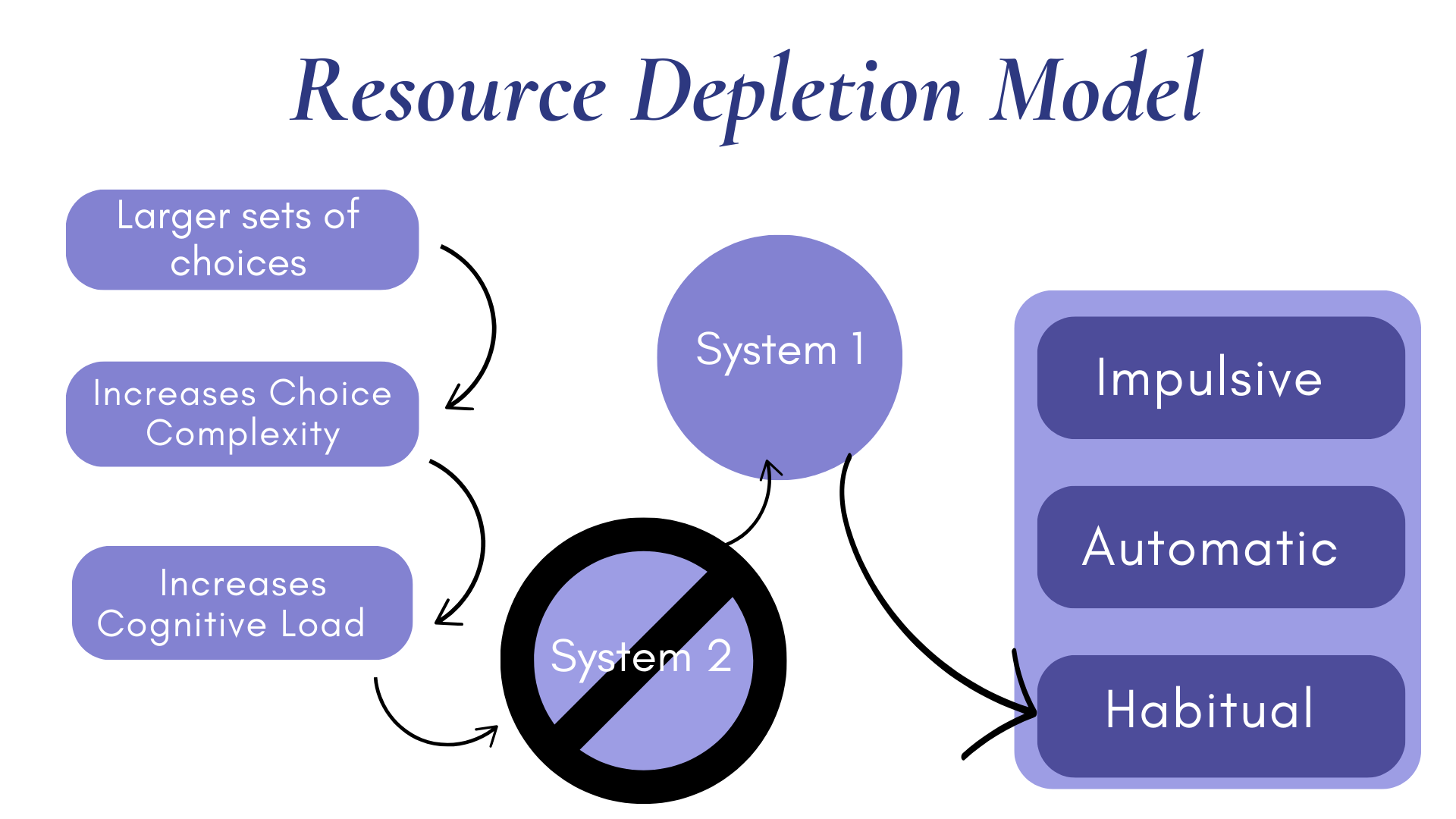
Figure 1: Resource depletion model
Decision fatigue can lead to greater reliance on system one, which is susceptible to biases and may lead to suboptimal choices. The level of decision fatigue rises proportionately with the complexity of a decision (Oto, 2012). In their review of existing literature, Pignatiello et al. (2018) note that decision fatigue can lead to procrastination and passive decision-making behaviour. They argue that reduced capacity in processing information processing and a reduction in assertion results in inadequate participation in the decision-making process. Furthermore, they also note that as the passive behaviour increases, individuals opt for not taking any decision at all. In addition, research by Tierney (2011) reveals that decision fatigue could also make individuals prone to ‘impulsive behaviour’. As a result, decision fatigue can lead to procrastination, passive behaviour or impulsive behaviour where individuals might delay making a choice, choose a default option, avoid making a choice at all or make a hasty choice. Consumer decision fatigue is influenced by product placement within a free-form, grid and racetrack layout.
Stage |
Cognitive Stage |
Behaviour |
Early |
High Engagement |
Analytical decision making |
Mid |
Cognitive Strain |
Heuristic Shortcuts |
Late |
Fatigue |
Avoidance/ Impulsive Behaviour |
Table 2: Decision fatigue outcomes
In a free-form store layout, products are arranged asymmetrically with the intent of increasing consumer engagement by encouraging ‘exploratory behaviour’ (Nguyen et al., 2022). Products within the store are placed in a dynamic, open space and do not follow a rigid aisle structure, inviting potential customers to explore at their own pace. In addition, departments such as apparel, footwear, beauty and accessories are blended on purpose rather than clearly departmentalised to allow the customer to explore items they had not intended to encounter, thus exposing them to a high volume of choices. However, by encouraging exploratory behaviour, consumers face choice paralysis, as the decision-making process becomes more complex. The lack of rigidity in the aisle structure means that the shopper invests more time comparing options, depleting their cognitive resources and increasing mental exhaustion as they evaluate multiple alternatives to find the best fit. As a result, customers may feel less satisfied with their choice due to the availability of increased choices, which had caused higher levels of decision fatigue. This overexposure to options exhibits the significance of striking the right balance between variety and cognitive manageability.
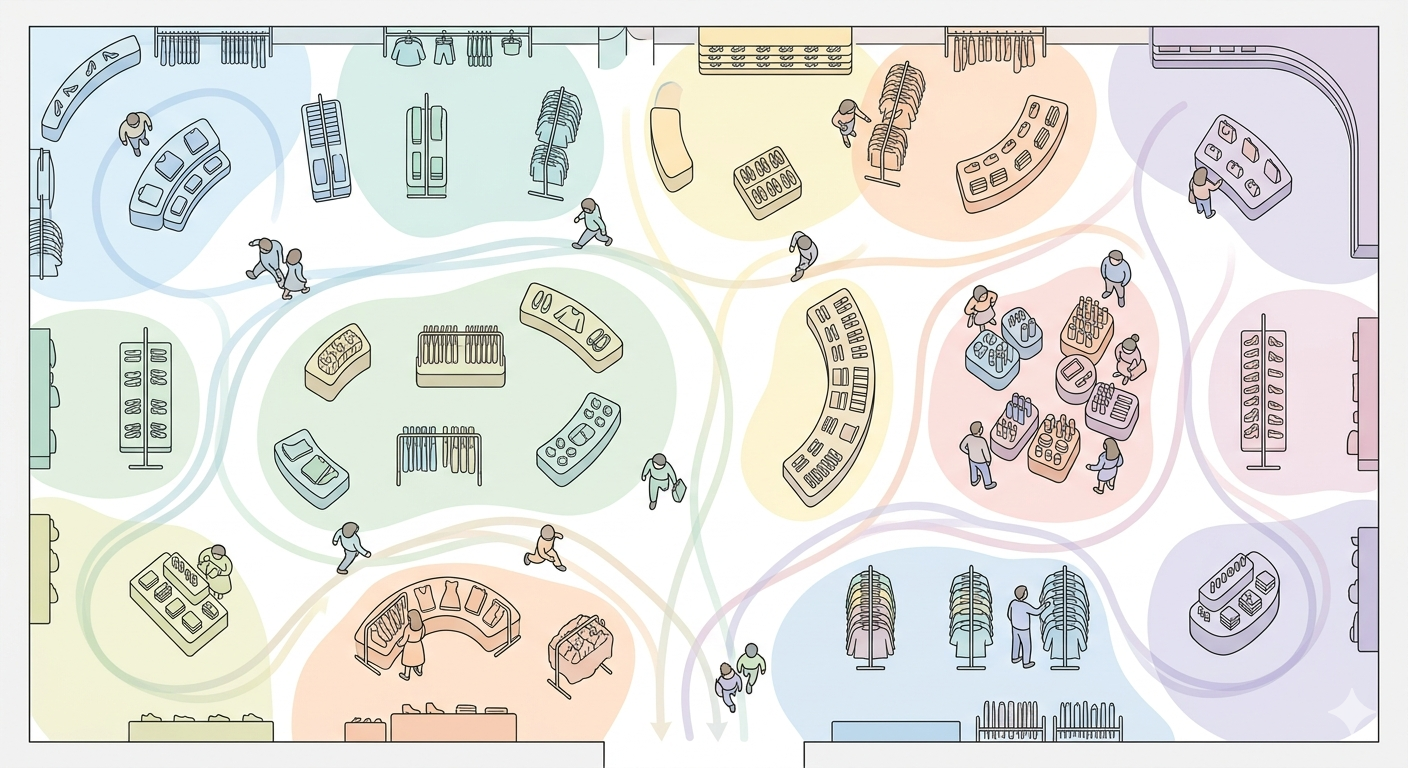
Figure 2: Free-form store layout
The grid layout strikes a right balance where the aisles are arranged in parallell and similar items are grouped together in dedicated zones. The grid layout is highly systematic as it allows the customer to easily navigate the products, enabling a structured and predictable shopping experience. Here the essential commodities and high-demand products such as milk, eggs or bread are placed towards the back of the store with the intent of increasing the visibility of other products and encouraging potential sales (Nguyen et al., 2022).
Although a grid layout is highly structured, allowing consumers to easily navigate products grouped together, shoppers can still become overwhelmed with the number of options in a single aisle. For instance, a snacks aisle may have crisps, biscuits and local snacks in different flavours and sizes. Consumers experience choice overload and spend a lot of time in the same aisle reading labels, browsing through various flavours and looking for discounts in an attempt to find the best deal. Upon experiencing overload, the customer may experience analysis paralysis and pick their default option, a product from a familiar brand. This is a form of passive behaviour that arises from the inability to process information. When this passivity increases, the consumer is most likely to not participate in the decision-making process any further, and may abandon certain purchases altogether. This aligns with Lyengar and Lepper’s ‘Paradox of Choice’, which suggests that the number of choices and number of sales are inversely proportional (2000). Moreover, encouraging customer to travel along the entire store to access essential commodities and high-demand products makes the shopper cognitively exhausted, leading to decision fatigue.
Applied retail examples further illustrate how product placement can influence consumer behaviour within such environments. For example, Walmart places baking supplies near holiday-themed snacks during festive seasons inviting the customers to make an easy choice by bundling similar products together (Shastri, 2023). Similarly, placing inexpensive items like sweets and chewing gum near the checkout counters activates impulsive buying behaviour, while positioning premium products at eye level, seasonal products towards the end of an aisle and bundling complementary items together are strategic placements that not only increase sales but also decrease the decision fatigue of a shopper.
As a result, the grid layout strikes a balance and is associated with moderate levels of decision fatigue due to structured aisles and strategic product placement.
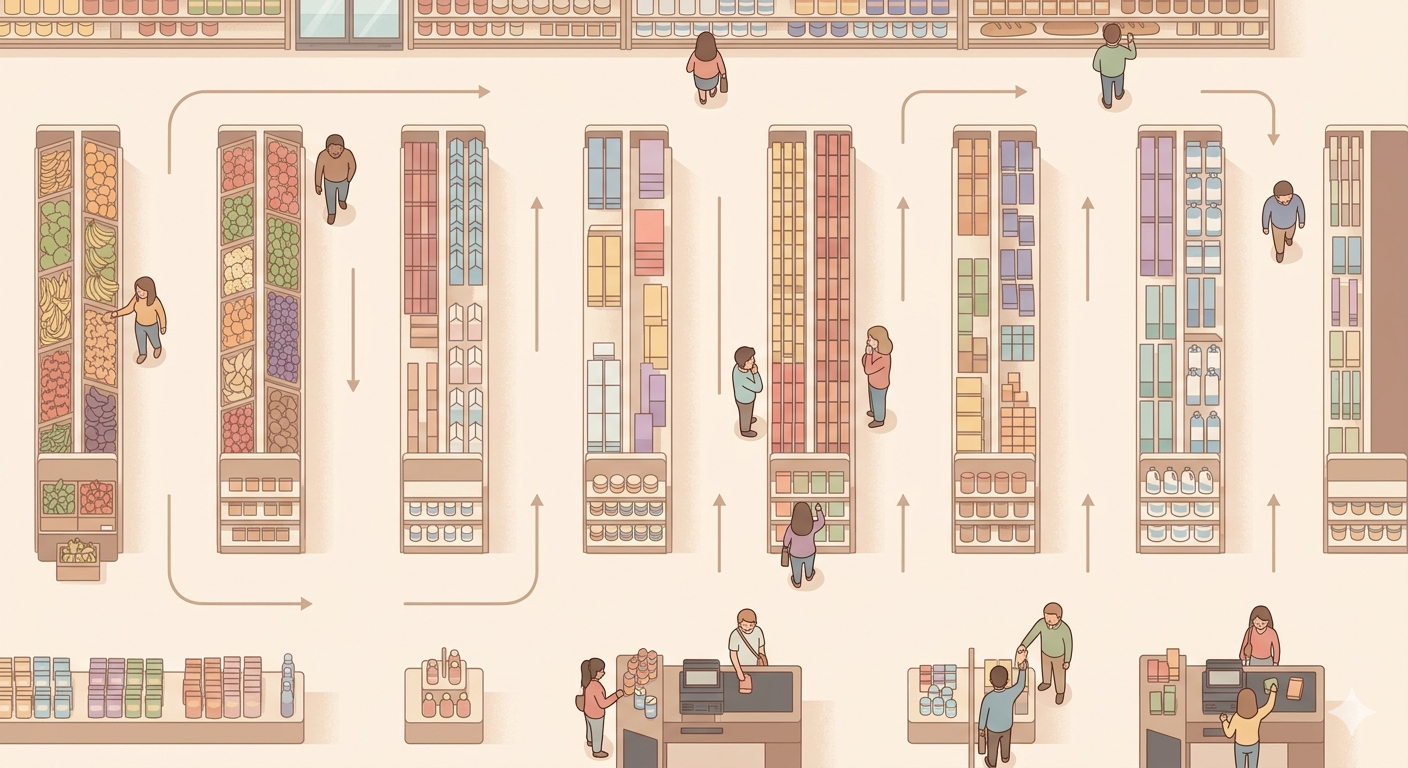
Figure 3: Grid layout
A combination of exploratory and strategic shopping experience is provided by a racetrack layout, also called a loop layout. Here one main aisle directs the customer throughout the perimeter of the store and exposes them to numerous products spread across different departments (Ijaz et al., 2014). The objective is to ensure that the customer encounters varied product categories and considers additional purchases before reaching the exit. In most store layouts, a consumer is only exposed to about 33 per cent of goods on sale. However, some department stores employ this loop layout to ensure that the customer is forced to travel through all the aisles, increasing the likelihood of additional purchases.
An applied example of this approach can be observed at IKEA, which employs a guided, maze-like, sequential pathway that directs consumers through different product categories. Additionally, the room-based displays present products within contextual settings, allowing consumers to visualise how individual products may function together. This example illustrates how product exposure is combined with a structured shopping experience within a racetrack layout (Clinehens, 2021).
In a racetrack layout, high-margin goods, seasonal products and promotional items such as discounted new arrivals are deliberately placed in prominent locations and become focal points. In contrast to a grid layout, where complementary items are placed close together, this layout places items from different categories together. For instance, unrelated items such as groceries, electronics and clothes are placed near one another, inviting shoppers to explore a wider range of products. A meta-analysis of consumer impulsive buying suggests that 40 to 80 per cent of total purchases within a departmental store may be impulsive (Amos et al., 2014). When consumers are exposed to unrelated categories, they may become interested and they are likely to explore products that they had not intended to, resulting in impulsive buying behaviour.
In addition, the checkout counters are placed near the exit to ensure that the customer is funnelled towards payment only after exploring all products presented in the loop. This ultimately increases the time a customer spends within a store browsing and engaging with the products. To minimise confusion, clear signage is utilised to direct customers to pathways to different sections. The guided path throughout the perimeter of the store and organised product placement in a logical order helps reduce the levels of decision fatigue among shoppers.
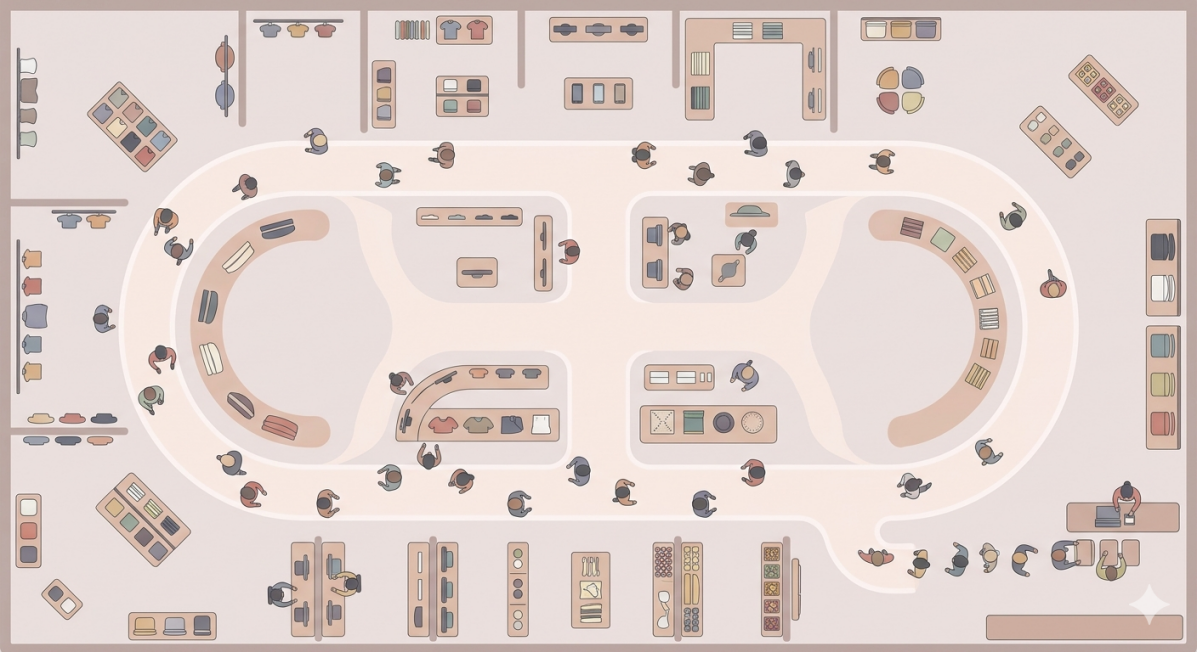
Figure 4: Racetrack layout
Layout Type |
Navigation Style |
Cognitive Load |
Decision Fatigue |
Consumer Behaviour |
Free form |
Unstructured |
Higher |
Higher |
Exploratory, fatigue |
Grid |
Structured |
Moderate |
Moderate |
Comparison, default choices |
Racetrack |
Guided |
Lower navigational demand |
Potentially lower |
Smooth decisions, impulsive buying |
Table 3: Layout comparison
The findings of this review suggest that the way consumers navigate and interact with different department store layouts, as well as the number of choices they encounter, influence decision fatigue. The review therefore argues that store layout does not simply increase or decrease decision fatigue but also shapes how cognitive effort is distributed across exploration, navigation and evaluation. The balance between structure and exploration across the three layouts examined establishes the foundation for the relationship between store design and decision fatigue. Cognitive effort is increased in a highly unstructured environment, which require consumers to evaluate and navigate products. However, an overly dense but structured environment can retain high levels of choice while reducing navigational complexity. A comparatively balanced approach is provided by the racetrack layout, which provides directional structure while continuing to expose consumers to a broad range of products.
Within the shopping process, navigation itself becomes an additional decision that the consumer must make. Consumers have greater autonomy to determine which products to explore and where to move in a free-form layout. Although this may increase engagement through exploratory shopping, it requires consumers to continuously make decisions about their next destination. The grid layout provides a predictable aisle structure where similar products are grouped together, reducing the burden of navigation. However, consumers may still encounter a large number of alternatives within a product category, thus reduction in navigation complexity does not necessarily eliminate cognitive overload. When considering the racetrack layout, this distinction is particularly important. Although the cognitive effort associated with deciding where to move next has been reduced, the same structure deliberately increases exposure to product categories that the consumer may not have initially intended to consider. Therefore, the racetrack layout may reduce one source of cognitive burden while simultaneously increasing opportunities for exploration. This suggests that the relationship between store layout and decision fatigue is better understood in terms of where cognitive effort is required, rather than simply if it is being increased or decreased.
In contrast, the relationship between the number of choices available and decision fatigue is not necessarily linear. Although the Paradox of Choice (Iyengar and Lepper, 2000) explains that limited assortment is more likely to drive purchase, subsequent research has challenged the assumption that larger assortments universally produce choice overload. In a meta-analysis of 50 published experiments involving 5036 participants, Scheibehenne et al. (2010) found that the average effect of choice overload was close to zero, although substantial variation existed across studies. Similarly, choice-set complexity, decision-task difficulty, preference uncertainty and the consumer’s decision goals have been identified as factors influencing the effect of assortment size (Chernev et al., 2015). These findings suggest that a greater number of product choices does not automatically mean greater decision fatigue. Instead, cognitive burden depends on other factors, including how certain consumers are about their preferences, how difficult the choice is and whether they are seeking efficiency or exploration. This qualification is particularly relevant when comparing store layouts, as a free-form environment may not necessarily mean fatigue for consumers who value exploration, while a highly structured environment like in a grid layout may still produce cognitive overload when consumers encounter numerous alternatives within a product category.
The review highlights that decision fatigue is a process rather than a single outcome. Initially, consumers may enter a store with relatively high cognitive resources and engage in deliberate comparison. However, cognitive strain may increase as exposure to alternatives and decisions accumulates, encouraging greater reliance on familiar choices and heuristics. At later stages, consumers may display impulsive purchasing, avoidance and passive decision making. The number of decisions that a consumer has to make and the manner in which those decisions are made can thus be influenced by store layout. This provides a broader explanation for why the same number of products may produce different behavioural outcomes depending on how they are organised.
Overall, the review suggests that a store layout is more than just a mechanism for organising products. It acts as a cognitive and behavioural interface between retail environments and consumers, shaping where cognitive efforts are required during the shopping experience. Effective retail design appears to manage where and when cognitive effort is required rather than reducing all forms of cognitive effort. Unnecessary navigational decisions can be reduced using greater structure, while strategic product placement can preserve opportunities for exploration. However, factors such as choice complexity, consumer preferenced and shopping goals determine the effectiveness of these strategies. Therefore, effective retail lies in structuring the environment so that consumers can make relevant choices with less cognitive burden.
When interpreting the findings of this review, several limitations must be considered. Firstly, the literature search primarily includes publications from 2000 to 2025 that were available for review through Google Scholar and Web of Science; therefore, relevant studies published outside the selected time frame or indexed in other databases have not been captured. Secondly, this review proposes the relationship between consumer decision fatigue and store layout based on empirical comparison and does not include primary data collected from consumers. Furthermore, consumer decision is influenced not only by store layout but also by other factors including shopping goals, prior knowledge, time pressure, individual differences and purchasing intentions.
Further research could provide a strong understanding by addressing these limitations through primary research, such as consumer surveys, controlled experiments or observational studies across different store layouts while holding the product assortment constant. To further examine whether different layouts alter the amount of visual and navigational effort required during shopping, eye-tracking or path-tracking methods could be used. The role of consumer characteristics such as preference certainty, familiarity with a shopping category and shopping goals in moderating the relationship between store layout and decision fatigue can also be investigated. Additionally, longitudinal or observatory research conducted in real retail environments could examine whether ease in navigation translates into quantifiable differences in product exploration, time spent in the store, purchase completion or purchase abandonment.
To sum up, the brain employs the dual decision-making model and utilises system one and system two thinking to make decisions. Nevertheless, each system has access to only a limited pool of resources, and when these resources deplete, cognitive ability decreases. The fear of making the wrong choices paralyses the ability to analyse, leading to decision fatigue. This results in greater engagement with system one thinking, making individuals prone to making impulsive, habitual and passive decisions.
Although a free-form layout allows the consumer to explore products and blends various departments together for higher sales, this configuration causes comparatively high levels of decision fatigue as it encourages browsing and consumers are left to navigate products by themselves. In this case, shoppers are required to make an extra decision regarding which path to choose and where to go next. In addition, the blending of related categories increases cognitive overload as it demands that the customers first evaluate and then filter a large number of options.
In contrast, a grid layout eases the navigation process by imposing a structure through parallel aisles. Even though the navigation is simplified, the availability of overwhelming choices in each category leads to a paradox of choice, resulting in passive behaviour where the consumer is most likely to choose a default or familiar brand due to the inability to process enormous volumes of information. Despite this, the consumer generally experiences only moderate levels of decision fatigue due to structured placement of premium products at eye level and bundling of complementary products.
The review indicates that the racetrack layout may reduce navigation decision burden in comparison to more unstructured layouts. However, cognitive demand could still be introduced with increased product exposure and opportunities for exploration. Therefore, the findings indicate that a racetrack layout may provide a comparatively effective balance between navigational structure, product exploration and consumer choice.
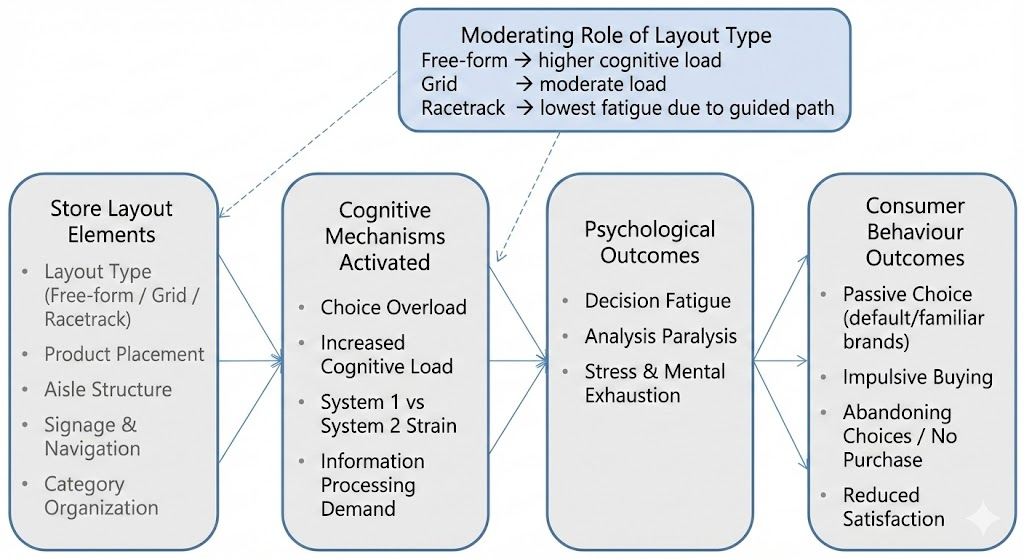
Figure 5: Impact of store layout on consumer behaviour outcomes
Figure 1: Resource depletion model
[Here the image has been designed and produced by the author of the article, so a description of the image is used with no need for a credit.]
Figure 2: Free-form store layout
[Image generated using artificial intelligence based on prompts designed by the author.]
Figure 3: Grid layout
[Image generated using artificial intelligence based on prompts designed by the author.]
Figure 4: Racetrack layout
[Image generated using artificial intelligence based on prompts designed by the author.]
Figure 5: Impact of store layout on consumer behaviour outcomes
[Image generated using artificial intelligence based on prompts designed by the author.]
Table 1: Literature search strategy
Table 2: Decision fatigue outcomes
Table 3: Layout comparison
Analysis paralysis: difficulty making a decision because of overthinking or considering too many possible outcomes.
Choice architecture: The way choices are organised and presented, which can influence how people decide.
Choice overload: A situation in which having many options makes choosing more difficult or less satisfying.
Cognitive resources: Limited mental capacity used for attention, memory, reasoning and decision-making.
Consumer decision fatigue: Reduced capacity or willingness to make decisions repeated ot demanding choices.
Heuristics: A mental shortcut used to make a judgement or decision more quickly.
Dual decision-making model: An approach that describes decision-making as involving both fast, intuitive processes and slower, more deliberate thinking.
Free-form layout: A store layout with a relatively open, less rigid arrangement that encourages browsing.
Grid layout: A store layout with aisles arranged in a regular, usually parallel pattern.
Product placement: The positioning of products within a store to shape visibility, navigation or purchase behaviour.
Racetrack layout: A store layout organised around a main route or loop that guides shoppers across different departments.
Amos, C., G. R. Holmes and W. C. Keneson (2014), ‘A meta-analysis of consumer impulse buying’, Journal of Retailing and Consumer Services, 21 (2), 86–97, available at https://doi.org/10.1016/j.jretconser.2013.11.004
Chen, J. (2022), ‘What is analysis paralysis? Definition, risks, and how to fix’, Investopedia, available at http://www.investopedia.com/terms/a/analysisparalysis.asp, accessed 2 May 2026.
Chernev, A., U. Bockenholt and J. Goodman (2015), ‘Choice overload: A conceptual review and meta analysis’, Journal of Consumer Psychology, 25 (2), 333–58, available at https://doi.org/10.1016/j.jcps.2014.08.002
Clinehens, J. (2021), ‘The Gruen effect: How IKEA’s store design makes you buy more’, Choice Hacking, available at http://www.choicehacking.com/2021/01/02/gruen-effect-ikea/?utm, accessed 2 May 2026.
Crivelli, D., C. Acconito and M. Balconi (2024), ‘Emotional and cognitive ‘route’ in decision-making process: The relationship between executive functions, psychophysiological correlates, decisional styles, and personality’, Brain Sciences, 14 (7), 734, available at https://doi.org/10.3390/brainsci14070734
Deck, C., S. Jahedi and R. Sheremeta (2017), ‘The effects of different cognitive manipulations on decision making’, available at http://bpb-us-e2.wpmucdn.com/sites.utdallas.edu/dist/8/1090/files/2022/03/cary_deck_paper.pdf, accessed 2 May 2026.
Elbers, T. (2016), ‘The effects of in-store layout-and shelf designs on consumer behaviour’, Wageninger University & Research, available at http://www.madsenwire.com/content/uploads/2019/01/edepotair_t56a79427_001.pdf, accessed 25 August 2026.
Ijaz, M. (2014). ‘Efficient digital signage layout as a replacement to virtual store layout’, International Journal of Information and Electronics Engineering, 4 (4), 314–16, available at https://doi.org/10.7763/ijiee.2014.v4.455
Iyengar, S.S. and M. R. Lepper (2000), ‘When choice is demotivating: Can one desire too much of a good thing?’ Journal of Personality and Social Psychology, 79 (6), 995–1006, available at https://doi.org/10.1037//0022-3514.79.6.995
Loo, J. (2021), ‘System 1 and System 2 thinking’, The Decision Lab, available at http://thedecisionlab.com/reference-guide/philosophy/system-1-and-system-2-thinking, accessed 23 October 2026.
Nguyen, K., M. Le, B. Martin, I. Cil and C. Fookes (2022), ‘When AI meets store layout design: A review’. Artificial Intelligence Review, 55, 5707–29, available at https://doi.org/10.1007/s10462-022-10142-3
Oto, B. (2012), ‘When thinking is hard: managing decision fatigue’, EMS World, 41 (5), 46–50, available at http://www.researchgate.net/publication/225279309_When_thinking_is_hard_managing_decision_fatigue, accessed 25 August 2026.
Pignatiello, G. A., R. J. Martin and R. L. Hickman (2018), ‘Decision fatigue: A conceptual analysis’, Journal of Health Psychology, 25 (1) 123–35, available at https://doi.org/10.1177/1359105318763510
Scheibehenne, B., R. Greifeneder and P.M. Todd (2010), ‘Can there ever be too many options? A meta-analytic review of choice overload’, Journal of Consumer Research, 37 (3), 409–25, available at https://doi.org/10.1086/651235
Shastri, A. (2023), ‘Marketing mix of Walmart: How the world's largest retailer stays unbeatable’, IIDE, available at https://iide.co/case-studies/marketing-mix-of-walmart/?, accessed 20 December 2024.
Thaler, R. H., C. R. Sunstein and J. P. Balz (2010), ‘Choice architecture’, Harvard Public Law Working Paper, available at https://papers.ssrn.com/sol3/papers.cfm?abstract_id=1583509, accessed 23 October 2026.
Tierney, J. (2011), ‘Do you suffer from decision fatigue?’, available at https://maryluttrell.com/wp-content/uploads/2011/09/Luttrells-Excerpts-of-Tierney-Article-on-Decision-Fatigue.pdf
Verhagen, C. and W. De Baene (2020), ‘Cognitive depletion, ego depletion, and working memory’, Tilburg University, available at http://arno.uvt.nl/show.cgi?fid=151908, accessed 19 January 2026.
To cite this paper please use the following details: Agarwal, P. (2026), 'To What Extent Does the Layout of a Departmental Store Affect Consumer Decision Fatigue?', Reinvention: an International Journal of Undergraduate Research, Volume 19, Issue 2, https://reinventionjournal.org/index.php/reinvention/article/view/2405. Date accessed [insert date]. If you cite this article or use it in any teaching or other related activities, please let us know by emailing us at Reinventionjournal@warwick.ac.uk.
https://doi.org/10.31273/reinvention.v19i2.2405, ISSN 1755-7429 © 2026, contact reinventionjournal@warwick.ac.uk. Published by Warwick Education Academy, University of Warwick. This is an open access article under the CC-BY licence (https://creativecommons.org/licenses/by/4.0/)