Maisie Howard, University of Leeds
The focus of this paper is the epistemic injustice of automatically not believing someone’s testimony of a mystical experience simply because they had an illness at the time. This can lead to people diminishing the subject’s perceived epistemic credibility as they may be stereotyped as not being able to reason effectively due to their illness. This is epistemic injustice as a subject’s words are silenced because they are believed to be an untrustworthy knower due to a negative prejudice associated with a disadvantaged group to which they belong (such as having an illness). The revelations of Julian of Norwich provide the central focus of this paper, and I utilise research from a range of subjects, such as theology, philosophy, psychiatry and history, to reach my conclusion. I argue that not all people who are ill and claim to have had a mystical experience (such as Julian of Norwich) should be regarded as unreliable knowers, and that there can be experiences of God that have been triggered by an illness. This argument has important ramifications for how people with illnesses should be treated epistemically as well as the position that religion can have in medicine.
Keywords: Epistemic injustice and illness, mystical experiences and psychiatry, Julian of Norwich, intellectual humility, medicine and religion
Just over 650 years ago, Julian of Norwich had transformative experiences that she believed came from God, involving visions and revelations centred around the Passion of Christ. Julian was a young woman when she had these experiences and later became an anchoress at St. Julian’s Church in Norwich. An anchoress was someone who lived a contemplative life within a cell attached to a church, who gave up possessions and community to focus on God (Jantzen, 2000: 30). Within her cell, Julian reflected upon her experiences for 20 years, which led her to produce a complex and mature theology about the love of God around us. Her work has helped people navigate suffering in their lives, grow spiritually and unite further with God (Jantzen, 2000: 205). She has therefore developed an important piece of writing based around these believed revelations, or mystical experiences (MEs).
If these experiences are considered to not be of God because they may have been triggered by an illness, the meaning of Julian’s experiences and theology could be perceived to be lost, along with the possibility for spiritual healing that they offer. Julian’s work contains two texts, the Short Text (ST), which most believe was written just after she had her MEs (1373), and the Long Text (LT), which was written around 20 years later, in 1393, following deep reflection on the meanings behind her experiences (Julian of Norwich, 1998: xii). Together, these texts constitute her work Revelations of Divine Love, the first book ever written in English by a woman. For six centuries, Julian’s work remained largely unheard and she was not a well-known figure until the early twentieth century, when Grace Warrack translated it into modern English in 1901 and presented a supportive approach to Julian’s ideas, which made them more popular (Ramirez, 2016: 81).
Section 1 will argue that Julian had a physical illness during her MEs that affected her mental state. This may lead some to question the reliability of her understanding of her MEs and whether they were of God. In Section 2, I will showcase a discussion in psychiatry about how to discern whether an experience is spiritual or attributable to psychopathology. I argue that the two are not mutually exclusive – that pathology can trigger an ME. Finally, Section 3 discusses the epistemic injustice that occurs when MEs are automatically dismissed due to negative stereotypes associated with illnesses. I also discuss the importance of intellectual virtues in ascertaining the reliability of a knower.
This paper presupposes that God could exist but is not arguing for the existence of God. Instead, I argue that it is possible that Julian had an experience of God and, due to her intellectual virtuosity, we should take her account of her MEs seriously to avoid committing epistemic injustice. Julian’s MEs will foreground these arguments and will provide evidence to the overall argument that modern society should be more open to the value and knowledge that can be found in MEs, particularly as it tends to value scientific over religious knowledge (Kidd, 2017: 391−92). This will potentially help to reduce the suffering of those with illnesses, as it encourages us to treat them as epistemic agents with knowledge to share with the world. There is little in the literature applying epistemic injustice, epistemology or psychiatry to Julian of Norwich, and this paper offers a novel way of approaching the nature of MEs through its interdisciplinary research.
Epistemic injustice is a term coined by Miranda Fricker, who describes it as being when ‘someone is wronged specifically in their capacity as a knower’ (Fricker, 2007: 1). This can manifest as a speaker not being believed and their knowledge of the world being undermined unfairly. It is an injustice as it disproportionately happens to people from oppressed or disadvantaged groups (Fricker, 2007: 27). The type of epistemic injustice with which this paper is primarily concerned is testimonial injustice, which occurs when a person’s testimony is silenced due to a belief that they are an unreliable knower because they belong to a certain disadvantaged group. This judgement stems from a negative prejudice of their social identity and is not based on genuine reasons that someone may not be a credible knower. I will apply the concept of epistemic injustice to people who have experienced unusual mental phenomena as a result of an illness, who are therefore likely to be deemed irrational and given less perceived epistemic credibility (Kidd and Carel, 2017: 175). This diminished credibility comes from a negative prejudice that people with illnesses are unable to be epistemic agents with respect to their own experiences of illness.
In addition, I will explain what I mean by mystical experience. As explicated by Ian Kidd, religious experiences are an ‘experience of absorption in, union with, sense of or a something whose reality is not only denied but also excluded by a naturalistic picture of the world’ (Kidd, 2017: 393). This means experiencing anything that cannot be proved by science and whose existence could be up for debate, such as a spiritual being like God. There can be a lot of discussion around differences between religious and spiritual experiences but for clarity, in this paper, I treat them as the same. I thus regard MEs as a type of religious or spiritual experience that acquaints the subject first-hand with God’s presence, whether that be visually, emotionally, auditorily or through a non-sensory deep knowing.
Julian’s work highlights her MEs – for example, describing the feeling of God’s love. She recalls: ‘And our Lord’s next showing was a supreme spiritual pleasure in my soul. In this pleasure I was filled with eternal certainty, strongly anchored and without any fear’ (Julian, ST: Ch. 9). Here she becomes acquainted with what it is like to feel the presence of God and therefore has had an ME.
This section provides background information on Julian, discussing the unusual mental experiences she had as well as the likelihood that she had a mental illness during this time. Little is known about the context of Julian’s life; she details only her experiences and their meaning, and she makes it clear that she herself is not important. She mentions very little of her life, and her entire work is focused on her experiences and what they mean for Christians. What is known of her life is that she was 30 years old when she had these experiences and they occurred on 8 May 1373 (Jantzen, 2000: 4). It is also likely that she was no stranger to suffering, having lived through the Black Death, poor harvests, declining cattle yields and religious violence against the Lollards (Jantzen, 2000: 7–11). Grace Jantzen explains that this has given her book ‘a deep sensitivity to suffering and dying’ (Jantzen, 2000: 8). This could be why her work has resonance with many people today and is often connected with helping those who are suffering from mental distress. Jantzen describes her texts as being tools for spiritual healing, writing:
She offers incredible insight into how we may begin to move into the healing and delight of God, reversing the shattering effects of sin and developing an integrated and happy personality.(Jantzen, 2000: 205)
Despite her own suffering, Julian’s work can help those who are struggling to get through difficulties in life. She writes: ‘I am, I hope, in oneness of love with my fellow Christians; for upon this oneness depends the life of all who shall be saved’ (Julian, LT: Ch. 9). She transformed her experiences into fruits to help others, and her intention was to unite Christians in their love for God.
Fortunately, we can understand Julian’s experiences to a larger extent as they are foregrounded in her work. She seemed to have had a range of types of experience, with some being entirely in the mind and some being sensory. Her visual experiences, for example, fell into two categories: ‘bodily sight’ and ‘spiritual sight’ (Julian, ST: Ch. 5). Her first ‘showing’ is described as a ‘bodily sight of the plentiful bleeding of Christ’s head’, which she saw as she stared into a crucifix (Julian, ST: Ch. 5). It is difficult to reach a definitive conclusion about what this category entails as she fails to explain it in detail. However, it could be argued that it refers to a physical sight rather than an image experienced in the mind (Cook, 2023: p. 56).
Within the same revelation, Julian is shown a spiritual sight of ‘a little thing, the size of a hazel-nut, lying in the palm of my hand, and to my mind’s eye it was as round as any ball’ (Julian, ST: Ch. 4). This spiritual sight appears to refer to revelations that come to the mind rather than a vision perceived by the eyes. Although the experience is pictorial, she cannot physically see it; rather, it appears to her internally. Spiritual visions for Julian can also involve insight into the meanings behind what she is shown by God. For example, she is also given ‘a spiritual vision of his [God’s] familiar love. I saw that for us he is everything that is good and comforting and helpful’ (Julian, ST: Ch. 4). Although this is not something that can be physically seen, it is still understood by Julian as sight.
Augustin Poulain offers some more insight into spiritual senses, describing them as having a ‘strong resemblance’ to physical senses whereby God communicates ‘intellectually’ rather than through the physical sense organs (Cook, 2019: 213). Julian also reports hearing voices. For example, shortly after she witnessed the bleeding of Christ, Julian heard a voice from God, which occurred ‘without any voice or opening of lips, there were formed in my soul these words: “By this the Fiend is overcome”’ (Julian, ST: Ch. 8). Although she was sure it was from God, there was no voice outside of her and she understood the meaning of the words within her soul.
It is common in modern society to look for non-religious explanations of how MEs occur, often looking towards psychiatry and medicine for explanations. This is a view leftover from the Enlightenment in which religious belief was seen as ‘epistemically suspicious’, and science was favoured as an ‘epistemically privileged perspective on reality’ (Kidd, 2017: 392). I will therefore discuss the possibility that Julian had a mental illness during her showings.
There is scarce evidence to ascertain whether Julian had a mental illness or not. As Christopher Cook explains, retrospective diagnoses can be difficult as they rely on historical sources that are not focused on the information needed today (Cook, 2023: 16). In addition, Jutel and Russel argue that retrospective diagnoses find meaning only in superficial medical categories in an attempt to explain things that do not make sense, rather than take seriously any religious or existential interpretations (Jutel and Russel, 2021; as cited in Cook, 2023: 16). I will therefore apply any psychiatric interpretation of Julian’s MEs with caution.
There is little in the literature arguing that Julian had a long-lasting psychiatric disorder. Some scholars argue for her sanity, for example, Grace Jantzen who argues that, due to Julian’s humility, her warning against desiring to have these experiences, and her intention of increasing ‘in true contrition, loving compassion, and a longing of the will of God’, she was in her right mind when she prayed for and had her MEs (Jantzen, 2000: 80–82). This is because she shows an understanding that what she experienced may not be beneficial for everyone to go through first-hand, but what is most important is the meaning of these experiences to influence people’s lives. She did not regard her MEs as absolute and did not consider herself the ultimate knower of God’s nature because of them.
Although Julian may have been sane in her usual state, while she had these experiences, it is likely she was suffering from a somatic illness. She writes: ‘God sent me a bodily sickness in which I lay for three days and three nights; and on the fourth night I received all the rites of Holy Church and did not believe that I would live until morning’ (Julian, ST: Ch. 2). As she explains, she had prayed for this sickness in her younger years so that she would believe she was going to die as she thought it would help bring her closer to God:
I wanted this bodily sickness to be to the death, so that I might in that sickness receive all the rites of Holy Church, that I might myself believe I was dying […] I hoped it might be to my benefit when I died, for I longed to be soon with God.(Julian, ST: Ch. 1)
Some scholars believe this sickness triggered her experiences. For example, Cook – writing from a psychiatric background – puts forward the idea that it is likely Julian had botulism at the time, which would have meant that ‘her mental state was yet in some way still altered by the infective process’ (Cook, 2023: 59). During this illness, her mind was probably affected, which could have triggered her experiences. Cook also argues she experienced delirium from her illness as she had varying levels of consciousness alongside her MEs (Cook, 2023: 61).
Even Julian herself questioned her MEs, believing she was raving from her illness. She explains that she saw a religious man after her first day of MEs and said to him: ‘I had been delirious today’ (Julian, ST: Ch. 21). After she explained what she had seen, however, the man was very serious, which made her reconsider her understanding of her MEs and she came to regard her revelations as genuine. It is therefore likely that Julian experienced a short-term physical illness that affected her mental state and triggered her MEs. However, as argued in the next section, this explanation does not mean that they could not be of God.
As Julian had an illness that affected her mental state, many may believe her MEs were not of God – particularly those working in psychiatry who tend to favour diagnostic explanations over spiritual meaning-making (Cook, 2023: 1). This section will discuss a debate featuring work from psychiatry, philosophy, psychology and theology about the nature of MEs. This is to ascertain whether MEs can be from God, or whether they can be explained solely in psychiatric terms. The question at hand discusses how to differentiate spiritual experiences from pathological ones. This is important as it helps us to understand whether Julian could have had an experience of God.
A key piece of work in this debate comes from Mike Jackson and K. W. M. Fulford who argue that some experiences, which display similarities to pathological illnesses, are in fact spiritual experiences that are separate from psychopathology (Jackson and Fulford, 1997: 41). This argument is based on the findings of Jackson in 1991 (Jackson and Fulford, 1997), who used case studies of patients who could be diagnosed with psychotic symptoms (using the Present State Examination), but whose experiences resulted in the patient being ‘healthy and adaptive’ rather than ‘pathological and maladaptive’ (Jackson and Fulford, 1997: 50). According to these authors, the outcome of the experience dictates whether it is pathological or not, rather than its ‘form’ (the type of experience) and ‘content’ (what the experience consisted of), which is how psychiatry has traditionally diagnosed them (Jackson and Fulford, 1997: 50). They argue that these experiences can be beneficial to the subject, which runs counter to medical understandings of psychosis and hallucinations as being inherently negative (Jackson and Fulford, 1997: 55). To these researchers, experiences that positively affect a patient and become embedded in their values and beliefs are spiritual (Jackson and Fulford, 1997: 55). Spiritual experiences (and thus MEs) are argued to be ‘action-enhancing’ and ‘benign’ (Jackson and Fulford, 1997: 60). This means the subject gains something positive from them, such as helping them get through a difficult period in life or helping them to be better adjusted socially.
This position seems plausible; it makes sense that spiritual experiences that cause us harm may be attributable to mental diseases, whereas those that benefit our lives may be understood as originating from a power greater than us who has our best interest at heart, such as an omnibenevolent God. This idea also reflects the Christian method of understanding the fruits of an experience to discern its spiritual basis. However, as noted by Mohammed Rashed, Jackson and Fulford’s argument prioritises material values over religious concerns (Rashed, 2010: 191). Within the DSM-IV, psychotic symptoms and accompanied by social dysfunction can result in a diagnosis of schizophrenia (Rashed, 2010: 188). Social functioning includes ‘work, interpersonal relations, and self-care’ (Rashed, 2010: 193). However, this definition fails to account for the value placed on suffering in many religions. Many MEs are so life-changing for the subject that they can result in work and personal relationships changing, which can cause suffering (Scrutton, 2023: 9). In addition, suffering may be an important part of the experience itself, and positive fruits can arise from it.
In Julian’s case, she wished to experience the suffering of Christ so that she may love and know Him better: ‘my intention was this: that afterwards, because of the showing, I would have a truer perception of Christ’s passion’ (Julian, ST: Ch. 1). She did not wish to suffer for its own sake but rather had a purpose of spiritual growth in mind. As Jantzen argues, although Julian’s experiences were grounded in suffering, they ultimately resulted in wisdom to help others in their spiritual healing (Jantzen, 2000: 205). For example, she gives advice on how to deal with suffering, such as fostering ‘in ourselves a spirit of delight in the Lord’ (Julian, cited in Jantzen, 2000: 216). From her suffering, Julian creates ‘a setting in which pain can be resolved and life can be celebrated’ (Jantzen, 2000: 216). Therefore, suffering can be seen to be beneficial to a subject in their spiritual life.
In addition, Tasia Scrutton puts forward an idea that some experiences of suffering (such as having a mental illness) can be potentially transformative for a subject and help them to spiritually grow (Scrutton, cited in Finley, 2023: 59). On this account, such experiences are understood as being potential sources of meaning for those who undergo them, rather than being inherently good or bad (Finley, 2023: 60). Julian’s MEs could be read in this way, as she found rich meaning in her experiences and used them to help others. Although some of her experiences were not pleasant and she was in pain due to her illness, she found meaning in them and transformed her suffering into a book centred on divine love.
Julian chose to live as an anchoress following her MEs so she could achieve these ends. Today it would likely be seen as detrimental to a person’s wellbeing to isolate themselves from the world so they could contemplate God. However, for Julian, this gave great clarity to her experiences and helped her to produce guidance that has helped people for over 650 years (Cook, 2023: 61). Experiences of suffering are therefore not necessarily an indicator of mental illness and are not a helpful way to rule out spiritual experiences.
A different way of interpreting spiritual experiences and mental illness is through a both-and lens. This approach proposes that both spiritual and pathological experiences can occur at the same time, and some versions argue that they can be caused by one another. According to this view, the two are not mutually exclusive, and there can be a reason that they occurred together. As described by Scrutton, there are several different ways to view this account, but I take the one most useful in understanding Julian’s MEs to be the ‘honeysuckle on a broken fence view’ (Scrutton, 2023: 5). This is where someone may encounter something undesirable, such as an illness, which God subsequently uses to bring about deeper wisdom and understanding of Godself (Scrutton, 2023: 5). This is a type of potentially transformative experience.
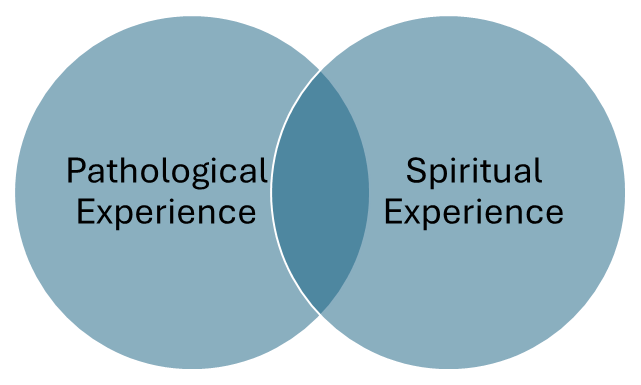
As argued above, it is likely that Julian suffered greatly during both her experience and her lifetime. Although negative things had happened to her, God helped her to overcome these through love and unity. Scrutton argues that God can be experienced both during the suffering but also in the period of healing and reflection afterwards (Scrutton, 2023: 19). We can see this in Julian’s case as she took 20 years to reflect on her experiences and wrote ‘one of the great works of theology in any language by any author’ (Turner, 2011: x). Spiritual and pathological experiences can therefore overlap without losing either the spiritual significance of MEs or the importance of the treatment and diagnosis of pathology (see Appendix for an illustration of this argument).
A both-and account overcomes most forms of epistemic injustice committed by diagnosing an ME solely as being caused by a medical condition. A person may have an illness, while also having encountered God. Diagnosis approaches that treat spirituality and psychopathology as mutually exclusive make it harder for a patient’s testimony of MEs to be heard and believed, raise questions about the reliability of them as a knower, and put forward a worldview that understands science as being able to explain away spirituality.
The next section will discuss how epistemic injustice is committed against patients within psychiatry and the harm that this can cause patients. I will also discuss the importance of intellectual virtues so we can better understand who is a reliable knower and avoid committing testimonial injustice. I argue that Julian was a reliable knower despite having an illness that may have triggered an ME, meaning it is likely there are more reliable knowers that need to be listened to who have or have had illnesses which affect their psychological state.
According to Fricker, negative stereotypes play a significant role in causing epistemic injustice, and they can influence people both consciously and subconsciously (Fricker, 2007: 27–28). Within psychiatry, there can be pervasive negative stereotypes of people with mental illnesses as being unreliable knowers as they are believed to lack ability to reason effectively and overcome emotion (Crichton et al., 2017: 3). This can unfairly lead to the dismissal of testimonies of people with mental illness as they are believed to be unable to accurately form beliefs (due to having impaired cognitive abilities) or share their knowledge (Crichton et al., 2017: 1). As explained above, it is likely that Julian experienced psychological phenomena caused by a physical illness. There is therefore a danger that she may be considered to be an unreliable knower and, if her MEs are reduced solely to pathology, they may be dismissed and deemed insignificant. Cook explains that many people who have similar abnormal experiences today end up with a psychiatric diagnosis, rendering those experiences meaningless to the subject (Cook, 2023: 96). This results in the psychiatrist committing testimonial injustice as a patient is silenced because they are unfairly deemed an unreliable knower due to their illness.
In addition, there are widespread stereotypes of people with illnesses (physical or mental) as being associated with ‘incapacitation, disability, diminished agency, social vulnerability, psychological fragility, and body failure’ (Kidd and Carel, 2017: 176). They are thus perceived to have low epistemic capacities, such as being impaired by their worries of mortality or being too emotional to think logically (Kidd and Carel, 2017: 176–77). Problematically, such assumptions are commonly found in healthcare settings, meaning ill people are especially at risk of epistemic injustice. Crichton et al. (2017: 9) argue that due to the proliferation of epistemic injustice of psychiatric patients, we should take the testimony of such patients as truthful ‘unless there is good reason not to do so’. This is because only they have access to what they have experienced and only they know whether they are misconstruing the truth (Crichton et al., 2017: 3). This gives them credibility automatically through direct acquaintance of their experiences.
John Hick argues that for someone to form a belief on the basis of someone else’s testimony, it is only rational ‘if the belief is compatible with our other beliefs, supported as they are by the general body of our own experience’ (Hick, 1992: 310). Therefore, it would be rational for Christians to understand Julian’s MEs as truthful, which would help to avoid testimonial injustice from being committed in this area. For non-Christians, it is still important that Julian is taken seriously, but there is less imperative to believe and participate in her theology.
Although it is important not to dismiss someone’s testimony of illness straight away, one may still have concerns that Julian’s method of understanding her MEs was not reliable. However, one way of gaining knowledge is through being an intellectually virtuous thinker, and Julian is an example of this through her intellectual humility. As explained by Kidd, intellectual humility occurs when a knower aligns their confidence with their abilities (Kidd, 2015: 396). It relies upon three conditions: speaker capabilities, the confidence of peers in one’s knowledge and confidence in one’s methods (Kidd, 2015: 396). For example, intellectual humility appears in the weighting that Julian gives to her experiences compared to the teaching of the Church. Denys Turner explains that Julian felt a tension between these two sources and ultimately decided to place more authority on the Church: ‘For Julian, there are no grounds at all for any independent appeal to those shewings’ (Turner, 2011: 71–75). Instead of having unquestioning faith in her ability to interpret her experiences, she looked to an established theological source to help her and give her the authority she needed to write a theological book. She questioned both herself and her experiences, worked through tension between her revelations and the Church’s teaching, and wrote her own theology after 20 years of deep reflection (Turner, 2011: 70–73). This demonstrates someone who has thought through their claims and experiences and has spent a long time in reconciling inconsistencies.
Although there are other intellectual virtues Julian may have possessed, humility is an example of the good practice she had with her thinking and suggests that it is likely that her method of understanding her MEs was likely reliable, leading to knowledge about them. It is therefore important that we take her account of her MEs seriously.
This could bring into question whether people who have certain types of illness that affect rationality, such as schizophrenia, are excluded from being reliable knowers of their MEs. However, it is contested whether having schizophrenia does negatively impact all aspects of reason. Gareth Owen et al. found that people with schizophrenia demonstrated impaired commonsense reasoning but enhanced theoretical reasoning, meaning they were better able to apply the rules of logic than healthy individuals (Owen et al., 2007: 454). As explained by Owen et al., there is an ongoing debate within the philosophy of science about which type of rationality should take precedence, with many advocating for theoretical reasoning over commonsense reasoning (Owen et al., 2007: 454).
People who have schizophrenia do have the ability to understand and interpret their unusual mental phenomena; they just may use a different method (which is still highly regarded in academia ) to get to the truth. One may still question whether those with schizophrenia can have the intellectual humility to question their unusual mental experiences as it often seems these experiences are taken at face value. However, intellectual humility can be developed by people with schizophrenia. One such case is Michael Dickinson, who describes the way he has developed intellectual humility while living with schizophrenia (Dickinson, 2025: 844). He explains that:
clear beliefs and a willingness to change them when circumstances and evidence demand […is…] a kind of ‘intellectual humility’ because although I do care about truth—and as a consequence of caring about truth, I do form beliefs about what is true—I no longer agonize about whether my judgments are wrong.(Dickinson, 2025: 844)
According to Dickinson’s account, some people with schizophrenia may become so caught up in needing to know the truth of what they are experiencing that it can cause unnecessary distress in their lives. Learning to reason effectively without agonising over being wrong can greatly improve their quality of life and function as a way to reach intellectual humility. Therefore, people with schizophrenia do not necessarily have impaired reasoning and can be intellectually virtuous and able to gain knowledge about their MEs.
To conclude, automatically dismissing the testimony of people who have had an ME triggered by an illness constitutes a kind of testimonial injustice as it wrongly treats them as though they are not epistemic agents and cannot reliably share their experiences. This harms them, damages our epistemology and prevents others from growing spiritually from the testimony of others’ MEs that have been triggered by an illness. I argue it is possible for a person to have an experience of God and that, given Julian’s intellectual virtuosity, it is important that we listen to her account of her MEs to avoid committing testimonial injustice.
This paper has taken a theological approach, which means its presupposition of the possibility of the existence of God may make its arguments less convincing for those who do not hold this belief. The aim of this paper, however, was not to convince people that God exists, but rather to argue that there is an injustice in automatically silencing individuals who wish to express their experiences of God, especially when these experiences have been triggered by an illness. Such dismissal can harm those who wish to speak about their MEs as they are assumed to be unreliable knowers and may be discouraged from finding potentially valuable meaning in their experiences. This is an important argument to raise as it may help to correct epistemic injustice inflicted upon people with an illness who wish to testify about their MEs by acknowledging that their words should be taken more seriously and they should be treated as an epistemic agent, with dignity and personhood in a time when they are likely to be suffering greatly.
I wish to express my gratitude to Dr Tasia Scrutton who I had many interesting discussions with regarding this research and who inspired many of the points raised in this paper.
Figure 1: A diagram depicting the potential overlap of spiritual and pathological experiences as described in a ‘both-and’ argument.
DSM-IV: The fourth edition of the Diagnostic and Statistical Manual of Mental Disorders which was first published in 1984 and acts as a reference for psychiatrists to diagnose mental disorders
Epistemology: The theory or study of knowledge
Knower: Someone who partakes in and contributes to knowledge; someone with knowledge of a subject
Lollards: A group of Christians who were critical of the abuses of the Church (such as its wealth) and who called for its reform in the 14th century
Present State Examination: A standardised test using semi-structured interviews to assess an individual’s psychological state, first published in 1974 and commonly used in psychiatry
Cook, C. H. (2019), Hearing Voices, Demonic and Divine: Scientific and Theological Perspectives, London: Routledge.
Cook, C. H. (2023), Hearing Spiritual Voices: Medieval Mystics, Meaning and Psychiatry, London: Bloomsbury.
Crichton, P., H. Carel, and I. J. Kidd (2017), ‘Epistemic injustice in psychiatry’, British Journal of Psychiatry, 41 (2), 1–11, available at https://doi.org/10.1192/pb.bp.115.050682, accessed 26 January 2025.
Dickinson, M. (2025), ‘From vexing uncertainty to intellectual humility’, Schizophrenia Bulletin, 51 (4), 843–44, available at https://doi.org/10.1093/schbul/sbad173, accessed 21 January 2026.
Finley, K. (2023), ‘Mental disorder, meaning-making, and religious engagement’, Theologica: An International Journal for Philosophy of Religion and Philosophical Theology, 7 (1), 56–101, available at https://doi.org/10.14428/thl.v7i1.64203, accessed 27 March 2025
Fricker, M. (2007), Epistemic Injustice: Power and the Ethics of Knowing, Oxford: Oxford University Press.
Hick, J. (1992), ‘The rationality of religious belief’, in Geivett, R. D. and B. Sweetman (eds), Contemporary Perspectives on Religious Epistemology, New York: Oxford University Press, pp. 304–19.
Jackson, M. and K. W. M. Fulford (1997), ‘Spiritual experience and psychopathology’, Philosophy, Psychiatry & Psychology, 4 (1), 41–65, available at https://muse.jhu.edu, accessed 27 March 2025.
Jantzen, G. (2000), Julian of Norwich: Mystic and Theologian, London: SPCK.
Julian of Norwich (1998), trans. E. Spearing, Revelations of Divine Love, (ST and LT), Suffolk: Penguin Random House.
Kidd, I. J. (2015), ‘Intellectual humility, confidence, and argumentation’, Topoi, 35 (2), 395–402, available at https://link.springer.com, accessed 5 May 2023.
Kidd, I. J. (2017), ‘Epistemic injustice and religion’ in Kidd, I. J., J. Medina, and G. Polhaus Jr. (eds), The Routledge Handbook of Epistemic Injustice, London: Routledge, pp. 386–96
Kidd, I. J. and H. Carel (2017), ‘Epistemic injustice and illness’, Journal of Applied Epistemology, 34 (2), 172–90, available at https://10.1111/japp.12172, accessed 18 March 2025.
Owen, G. S., J. Cutting, and A. S. David (2007), ‘Are people with schizophrenia more logical than healthy volunteers?’, British Journal of Psychiatry, 191,: 453–54, available at https://www.cambridge.org, accessed 20 January 2026.
Ramirez, J. (2016), Julian of Norwich: A Very Brief History, London: SPCK.
Rashed, M. A. (2010), ‘Religious experience and psychiatry: Analysis of the conflict and proposal for a way forward’, Philosophy, Psychiatry & Psychology, 17 (3), 185–204, available at https://muse.jhu.edu, accessed 16 September 2024.
Scrutton, T. (2023), ‘Psychopathology AND religious experience?: Towards a both-and view’, Philosophy, Psychiatry and Psychology, 31 (3), 243–256.
Turner, D. (2011), Julian of Norwich, Theologian, London: Yale University Press.
To cite this paper please use the following details: Howard, M. (2026), 'An Enquiry into the Mystical Experiences of Julian of Norwich and Epistemic Injustice in Relation to Illness', Reinvention: an International Journal of Undergraduate Research, Volume 19, Issue 2, https://reinventionjournal.org/index.php/reinvention/article/view/2554. Date accessed [insert date]. If you cite this article or use it in any teaching or other related activities, please let us know by emailing us at Reinventionjournal@warwick.ac.uk.
https://doi.org/10.31273/reinvention.v19i2.2554, ISSN 1755-7429 © 2026, contact reinventionjournal@warwick.ac.uk. Published by Warwick Education Academy, University of Warwick. This is an open access article under the CC-BY licence (https://creativecommons.org/licenses/by/4.0/)