
By Dr Lovleen Kushwah, Dr Paulina Navrouzoglou and Dr Wenya Cheng
“Live the questions now. Perhaps then, someday far in the future, you will gradually, without even noticing it, live your way into the answer.”
— Rainer Maria Rilke, Letters to a Young Poet
The British Conference of Undergraduate Research (BCUR) is never a single moment in time. It is a living ecosystem which is active, adaptive, and interdependent, where curiosity, courage, and community continuously shape one another. It is a space where diverse ideas are shared and reignited, research directions are reconsidered, academic identities are formed and career pathways are explored in real time.
Rather than unfolding linearly, BCUR grows through relationships: between students and staff across UK and beyond; between formal and informal conversations; and between careful structure and spontaneous exchange. In this sense, BCUR 2026 at the University of Glasgow functioned more like a hive — dynamic, interconnected, adaptive and sustained by collective effort.
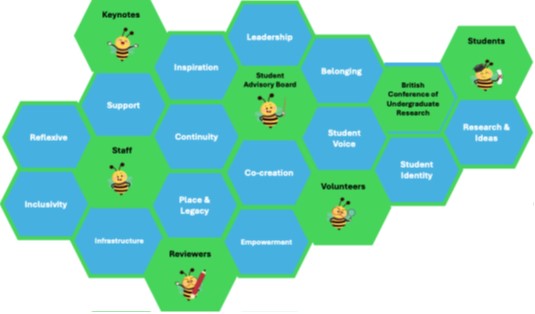
British Conference of Undergraduate research (BCUR) 2026 as a hive.
Organising BCUR 2026 was no small feat. Coordinating diverse commitments, ensuring accessibility, and securing the necessary resources required adaptability, shared commitment, and innovative solutions.
As the Organising committee team members and BCUR Executives, we began this journey at the Adam Smith Business School and were later joined by the wonderful Student Learning Development team, whose support was instrumental in maintaining both academic rigour and a genuinely inclusive, student-centred experience. We were also grateful for the generosity of abstract reviewers from institutions across the UK who helped shape a rich and diverse programme. The Adam Smith Business School Events Team handled the logistics and ensured everything ran smoothly. The Student Advisory Board played a vital role in shaping the conference from a student perspective, offering thoughtful input, ideas, and feedback that helped ensure the experience remained relevant, welcoming, and meaningful for participants. Student volunteers and session chairs provided the often‑unseen labour that allowed the conference to run smoothly, embodying the collaborative infrastructure upon which academic communities depend. The Organising Committee and Students’ Representative Council worked in close partnership throughout the planning of BCUR 2026. Co‑creation was not only a guiding principle but an everyday practice.
Our collaboration was rooted in a shared vision to create a meaningful student experience which helped us overcome challenges in organising such a large-scale event. The generous funding from the Chancellor’s, Ward's, and Adam Smith Business School Learning and Teaching Funds at the University of Glasgow, along with support from Glasgow City Council, provided the essential resources to make the event more accessible and resourceful.
The BCUR 2026 was hosted for the first time in Scotland at the University of Glasgow, which is one of the UK’s leading research intensive and historically significant universities. The conference was grounded in an environment where inquiry is both tradition and daily practice. Founded in 1451, the University of Glasgow has long been associated with intellectual curiosity and public scholarship, and the undergraduate research is not treated as peripheral, but as part of a wider continuum of knowledge production. The University of Glasgow has been committed to promoting undergraduate research, with its Let’s Talk About [X] (LTA[X]) conference, which has served as a cornerstone of the student research community for more than a decade now. In its 575th year, the University of Glasgow provided a setting where long‑standing traditions of scholarship intersected with emerging student voices, reinforcing the idea that research is continuously inherited, questioned, and reimagined.
The conference was also deeply shaped by place. Sessions were hosted across landmark sites including the James McCune Smith Learning Hub, Adam Smith Business School, Mazumdar‑Shaw Advanced Research Centre, Wolfson Medical School, and the Hunterian Museum. These spaces situated undergraduate research within a broader historical and institutional landscape, where past and present forms of inquiry coexist.
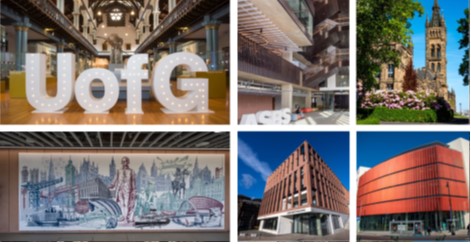
BCUR 2026 Venue
At the heart of BCUR 2026 was student engagement across disciplinary boundaries, research traditions, and methodological approaches. Students listened with attentively, asked thoughtful questions, and contributed with a shared willingness to embrace uncertainty. What we felt stood out most consistently was the atmosphere of care. Students supported one another across unfamiliar disciplines, engaged generously with different ways of knowing, and contributed to a sense of belonging that extended beyond institutional boundaries.
Around 500 people attended the conference, presentations took oral, poster, and creative forms, reinforcing the idea that research is not simply an outcome to be evaluated, but a process of exploration, interpretation, and dialogue. This ethos was intentional. We incorporated co-creation in our conference design, with the Student Advisory Board working closely alongside us to ensure that student voices were embedded not only in presentations, but in the structure and spirit of the conference itself.
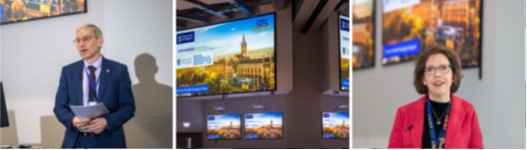
Professor Andy Schofield and Professor Moira Fischbacher Smith at the opening ceremony
Each day opened with keynote addresses that set the tone for the conference. On the first day, our Principal and Vice Chancellor, Professor Andy Schofield, welcomed participants, followed on the second day by the Vice‑Principal of Learning and Teaching, Professor Moira Fischbacher-Smith. Their reflections were deeply grounding, framing research not only as an intellectual endeavour but also as a practice that carries ethical responsibility. They spoke powerfully about the role of research in shaping students’ futures and supporting the development of future‑ready skills. Contributions from Professor Sayantan Ghosal, Professor Alison Phipps, Dr Tawona Sitholé, and Professor Petra Meier as our keynote speakers further encouraged participants to reflect on voice, responsibility, and impact, hence, prompting students to consider not only what research produces, but what it enables and whom it serves.
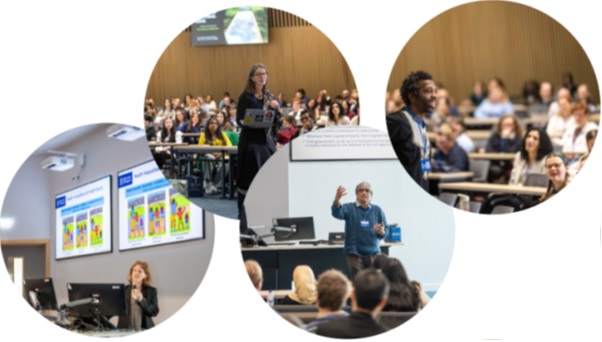
Clockwise: Professor Petra Meier, Professor Alison Phipps, Dr Tawona Sitholé and Professor Sayantan Ghosal.
BCUR 2026 highlighted the link between research and real-world challenges, with a focus on global and civic issues such as sustainability, responsibility and community engagement. We invited submissions across a wide range of topics, including sustainable futures, artificial intelligence, health and wellbeing, economic justice and human flourishing. Workshops and engagement sessions provided additional spaces for reflection, including opportunities for students to connect with alumni and to envisage future academic and professional pathways. In particular, a diverse range of workshops addressed themes such as research dissemination, the value of a degree, research and wellbeing, the role of the Commonwealth in Glasgow, and the reimagining of sustainable futures.
For many participants, BCUR 2026 marked a first encounter with an academic conference environment. Yet its significance extended well beyond this milestone. It offered a space in which emerging researchers have begun to see themselves differently, moving from the identity of student toward a growing sense of authorship and scholarly contribution within and beyond academia. Confidence developed not through competition, but through shared presence, encouragement, and recognition of both the rewards and challenges of conducting research.
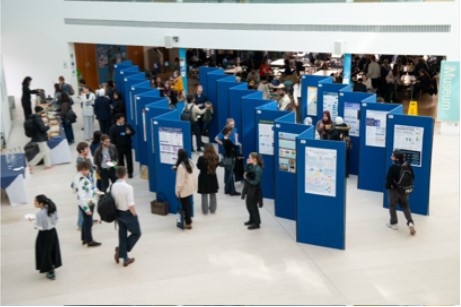
Posters at the Wolfson Medical Building
Amid the pressures and rhythms of academic life, the conference also offered a rare form of pause. Not a pause from thinking or working, but a pause to reconnect with purpose. Research was experienced as something creative and collaborative rather than purely evaluative. Informal conversations, moments of reassurance, and peer exchange carried as much weight as formal sessions, reinforcing the idea that knowledge is often formed in dialogue rather than delivered in isolation.
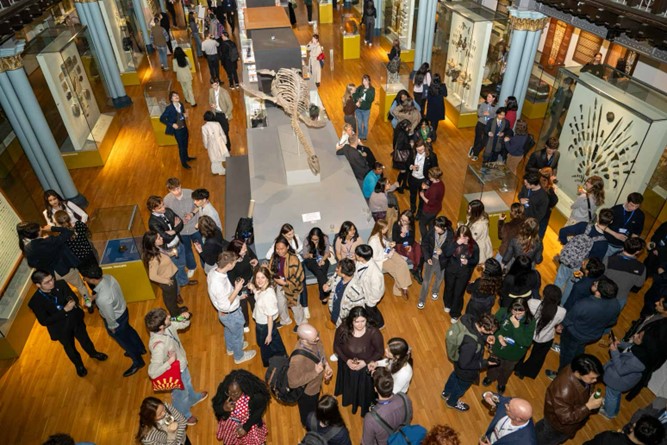
Glasgow City Council’s civic reception at the Hunterian Museum
As the conference concluded, attention naturally turned toward continuity. The metaphor of the hive remains fitting: activity does not end; it disperses and re-forms elsewhere. With stewardship passing to the next host institution, Queen Margaret University, London, the ideas, relationships, and confidence cultivated at BCUR 2026 continue to circulate, thus, shaping future research journeys and sustaining the wider undergraduate research community.
At BCUR 2026 we were reminded that, undergraduate research is not simply about answers, outputs, or conclusions. It is about cultivating confidence, sustaining curiosity, creating communities where questions are welcomed and ideas are allowed to grow and learning how to ask better questions together.
“Alone we can do so little; together we can do so much.”
— Helen Keller
To cite this paper please use the following details: Author, U. (2026), 'Unknown Title', Reinvention: an International Journal of Undergraduate Research, Volume 19, Issue 1, https://reinventionjournal.org/index.php/reinvention/article/view/2026. Date accessed [insert date]. If you cite this article or use it in any teaching or other related activities, please let us know by emailing us at Reinventionjournal@warwick.ac.uk.
https://doi.org/10.31273/reinvention.v19i1.2026, ISSN 1755-7429 © 2026, contact reinventionjournal@warwick.ac.uk. Published by the Institute for Advanced Teaching and Learning, University of Warwick. This is an open access article under the CC-BY licence (https://creativecommons.org/licenses/by/4.0/)