Navigating the Global Order through Trade and Discourse: EU’s Global Gateway and China’s Belt and Road Initiative in Africa
Sebastianas Dainius Uribe, University of Chester
Abstract
The European Union (EU) promotes the Global Gateway (EUGG) as a values-based model of infrastructure development, widely interpreted as an alternative to China’s Belt and Road Initiative (BRI). Both initiatives operate across overlapping geographies, particularly in Africa. This article explores how the EU narrates its identity through the EUGG in relation to China, and how that narrative reads against EU–China–Africa trade.
Drawing on Strategic Narrative theory, the study combines a critical discourse analysis of the four documents launching the EUGG with EU and Chinese trade data for six African countries (2001–23), analysed through correlation and lagged regression.
EUGG discourse names China only once, instead constructing the EU as a morally distinct partner through a dependency narrative and an undefined circle of ‘like-minded partners’. Trade data shows EU and Chinese trade moving in parallel rather than displacing one another.
The EU narrates distinction while its trade patterns reflect co-presence with China. Acknowledging that co-presence could bring the EU’s narrative closer to its own stated values of transparency and partnership.
Keywords: EU Global Gateway in Africa; EU’s silence on China; strategic narratives theory; EU–China–Africa relations; EU policy discourse; EU–China trade in Africa
Introduction
‘It does not make sense for Europe to build a perfect road between a Chinese-owned copper mine and a Chinese-owned harbour. [...] This is why we will soon present our new connectivity strategy called Global Gateway’ (Von der Leyen, 2021: 15).
These words by the President of the European Commission introduced the European Union Global Gateway (EUGG) as a flagship initiative to promote the European Union’s (EU) presence in global development. The initiative promises to mobilise €300 billion between 2021 and 2027 to finance ‘high-quality, rule-based’ infrastructure (Directorate-General for Communication, 2021a). The EUGG is often framed in contrast to China’s Belt and Road Initiative (BRI), the latter now in its second decade and having channelled over €1 trillion into transnational investment (Cui, 2023). Both frameworks promote development, facilitate trade and claim to enhance cooperation across multiple continents – often within the same countries. The overlap between the Chinese and European initiatives suggests that rhetoric of partnership may mask efforts to draw distinctions within a context of geopolitical competition.
In pursuit of democratic and just development, this article explores how the EU constructs and communicates its identity through the EUGG, particularly in relation to China’s BRI. It asks how the initiative’s launching documents portray the EU as a cooperative and/or competitive global actor, and how that narrative is reflected in the trilateral trade relationship between the EU, China and Africa. To this end, the article conducts a critical discourse analysis (CDA) of the official EUGG documents, informed by Strategic Narrative theory, to identify how the EU frames its rivals, partners and values. It then examines EU and Chinese trade patterns across Angola, the Democratic Republic of Congo, Egypt, Ethiopia, Kenya and Nigeria between 2001 and 2023, and evaluates where these material patterns align with, or depart from, the EU’s discursive framing – particularly the EU’s silence regarding China. This mixed and transdisciplinary approach allows a critical assessment of whether the EU’s constructed narrative enables collaboration or, conversely, sustains strategic separation within overlapping development arenas, and of the power implications of that choice.
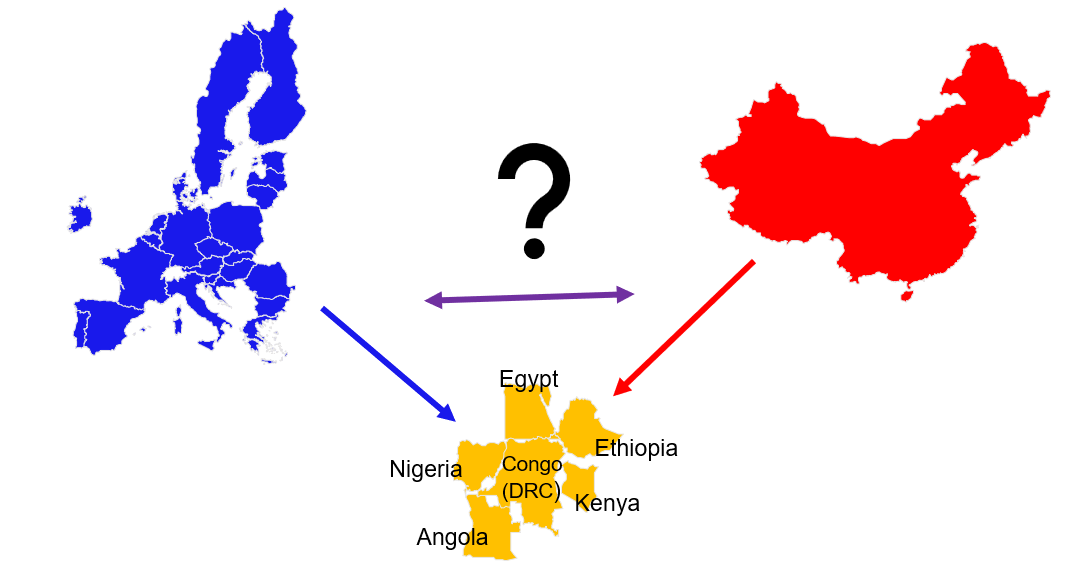 The article proceeds as follows: Part 1 reviews key academic and policy literature regarding the initiatives’ discourse, interlinkages and trade before introducing the Strategic Narrative theory used in the analysis (Miskimmon et al., 2013), complemented by a brief engagement with Said’s Orientalism (1978). Part 2 outlines the methodological approach, including the rationale for combining discursive and material analysis. Part 3 presents and discusses the findings, drawing links between discourse and trade flows. The final part concludes by reflecting on the implications for global cooperation and the discursive boundaries that continue to shape it.
Figure 1: The EUGG and China’s BRI operate in overlapping countries, which begs the question of the relationship in the space between them.
Literature review
This review begins by examining what the literature says about the EU constructing its image through the EUGG’s discourse. It then turns briefly to trade dynamics and economic structures to assess how material interdependence complicates or supports this identity performance. Finally, the review introduces Strategic Narratives theory by Miskimmon et al. (2013) as a tool to analyse identity, discourse and interconnectedness in global politics.
The literature surrounding the EUGG contains both critiques and proponents. The initiative, rather than signalling a new strategic direction, largely repackages existing aid and connectivity tools under aspirational language such as ‘high-quality’, ‘rule-based’ and ‘value-driven’ infrastructure (Clinci, 2022; Ganchev, 2024: 28; Kliem, 2021). Critics argue that this reflects a rhetorical rather than structural shift – forming part of the EU’s broader identity consolidation as a normative power (Esteban et al., 2023; Okano-Heijmans, 2024). This critique is reinforced by the fact that the EU’s Multiannual Financial Framework (MFF) for 2021–2027 was finalised prior to the initiative’s launch, suggesting that EUGG draws primarily on existing financial instruments (Furness and Keijzer, 2022; Heldt, 2023; Keijzer, 2024). Tagliapietra (2024) acknowledges these critiques, yet defends the EU’s unmatched donor role, citing €66.8 billion in Official Development Assistance in 2020. Either way, the emphasis on discursive framing rather than substantive innovation underscores the importance of examining how the EU constructs legitimacy and identity through language.
This leads to a recurring theme within the literature on discourse: the EU’s strategic silence regarding China. Clinci (2022) documents China’s absence from EUGG communications, while Heldt (2023) and Keijzer (2024) link this omission to geopolitical competition with China. Karjalainen (2023) describes this discursive contestation as a subtle mechanism that privileges EU-defined norms while marginalising alternative voices. Da Silva (2024), however, frames the EUGG as a performative defence of the liberal international order, in which the EU is positioned as the defender of rule-based infrastructure and global norms. The literature has established that the EUGG is shaped by competition with China and that China goes unnamed in its founding texts, yet discursive and material analyses have largely proceeded separately. This article brings the discursive and material strands together, examining how the EU’s silence is narrated and how that narrative reads against trilateral trade flows in the countries where both initiatives are present.
The EU’s implicit competitive framing of China rests on a contestable claim, that China creates dependency while the EU benignly builds partnership. While some scholars critique Chinese influence for producing dependency (Tarrósy, 2020; Taylor and Zajontz, 2020), others argue that this concern is often exaggerated, and serves to mask the EU’s own strategic interests (Bhuiyan and Yi, 2024; Ganchev, 2024; Gordon et al., 2020; Jones and Hameiri, 2020). The EUGG’s branding, then, may not be benign. As Christou and Damro (2024) and Abels and Bieling (2024) argue, these discursive strategies can obscure geopolitical and economic interests while foreclosing more inclusive modes of cooperation. They produce what Karjalainen (2023: 309) describes as a norms trap: a performance of partnership in which partners with limited resources have little room to decline cooperation on EU-defined terms. While some scholars, such as Ganchev (2024) and Kliem (2021), remain cautiously optimistic about the potential for more collaborative approaches, much of the literature suggests that the current discursive trajectory maintains separation rather than inviting dialogue. Furthermore, Tagliapietra (2024: 1335) frames the EUGG as an ‘attractive alternative’ to the BRI but presents China only as a rival, not a potential partner. This discursive distancing becomes even more complex when considered alongside trade dynamics, which challenge the narrative of strategic separation.
Empirical trade dynamics complicate the EU’s narrative of strategic rivalry with China. Infrastructure investments in EUGG countries lower trade costs for all actors, potentially also benefiting Chinese supply chains (Keijzer, 2024; Wolf and Poli, 2024). Nowak (2016) shows that while the EU held a trade advantage in Africa from 2000 to 2008, this reversed after the financial crisis, with China becoming the leading trading partner for exports in 13 countries and imports in 17 countries by 2014. Kareem (2010) complements this with earlier data, showing Africa’s exports to China grew from $357 million in 1990 to over $34 billion by 2007. While the EU’s trade position is supported by historical and linguistic ties, non-tariff barriers constrain African exports to both the EU and China (Kareem, 2010), complicating any clear distinction between a conditional European partner and an unconditional Chinese one. In this context, trade reveals a disconnect between the EU’s cooperative discourse and the delivery-based pragmatism shaping African choices (Abels and Bieling, 2024; Clinci, 2022).
Strategic Narratives Theory, as developed by Miskimmon et al. (2013), offers a framework capable of holding these discursive and material strands together. Strategic narratives are defined as ‘means by which political actors attempt to construct a shared meaning of the past, present and future of international policies to shape the behaviour of domestic and international actors’ (Miskimmon et al., 2021: 8). Read through this lens, the documents describing the EUGG cease to be merely descriptive accounts of connectivity policy. Rather, they become instruments that actively influence the geopolitical space they narrate. This encourages a focus on the words used and the actors mentioned and omitted in order to uncover the narrative that the EU is trying to create. It thereby recasts the way in which the EU addresses China from a simple observation into an analysable feature of narrative construction, and supplies the vocabulary in which the discursive and trade dimensions reviewed above can be read alongside one another.
Narratives are composed of identifiable features: actors, obstacles, tools to overcome them and desired or feared outcomes. Once an actor frames a series of events into a sequence, the narrative confers direction – a sense of whether the actor is advancing, stagnating, deadlocked, catching up or leading. Causal sequences of events also carry analytical weight, since it is causality that justifies credit and blame, and that makes a proposed course of action appear necessary rather than simply available. Applied to the EUGG, this vocabulary exposes the grounds on which the EU establishes the initiative as necessary and the stage at which it positions its existing partnerships. Paying attention to these features within EUGG documents and trade data allows us to interpret what narrative is being created (Hu, 2026; Miskimmon et al., 2021).
The framework disaggregates strategic narratives into three interlocking tiers. First, system narratives set out how an actor perceives the international order: what it was, what it is and what it is moving towards. This is combined with the normative preferences embedded in that trajectory; the how it should evolve (Hu, 2026; Miskimmon et al., 2021). For the EUGG, this is where the EU’s account of global connectivity and its rules are located. Second, identity narratives concern the actor’s construction of its own role within that order, and in doing so constrain the roles available to it – for example, donor, partner, competitor (Hu, 2026). This tier directly addresses what kind of global development actor the EU presents itself as being, and against whom it draws that self-definition. Third, issue narratives operate at the level of policy, specifying what should be done, why, with whom and to what end (Hu, 2026; Miskimmon et al., 2021). This is where the EU’s identity becomes actionable and where the terms of partnership – or lack thereof – are set. Taken together, the three tiers give the analysis its architecture, allowing the EU’s stated goals to be reconstructed at each level and read alongside the material record of trade.
Miskimmon et al. (2013) distinguish three processes of narration: formation, projection and reception. Reception is the most difficult to study, yet arguably the most consequential, since audiences interpret narratives through their own historical and cultural filters (Miskimmon and O’Loughlin, 2021: 29). This study examines the first two processes, analysing how the EU forms and projects the EUGG narrative while reflecting on the normative implications for its reception. Because the success of the EUGG depends on how partner countries in Africa receive it, the colonial history of these relationships makes reflexivity even more important. Li’s (2020: 3) reading of Said (1978) as ‘contrapuntal cosmopolitanism’ offers such reflexivity, defining the term as a form of humanism that resists fixed categories and embraces openness to difference. Said, and Li’s interpretation of him, provide normative ground for mutual recognition and the building of shared narratives.
Methodology
The choice of method follows from the theory. Miskimmon et al. (2021) distinguish between narrative and discourse: discourses are long-term bodies of knowledge in specific fields of practice that create stable subject positions and actor roles, whereas narratives are the time-sequenced structuring of linked events (Miskimmon and O’Loughlin, 2021). Treated as combinatory, discourse is the material from which actors craft and sustain their narratives (Miskimmon et al., 2021). To analyse the discursive substrate is therefore to analyse what narratives are made of. Furthermore, strategic narrative is advanced as a conceptual framework rather than a method, compatible with a range of systematic procedures and asking only that analysis be replicable (Miskimmon et al., 2021). Critical discourse analysis (CDA) supplies the systematic textual procedure that the framework requires. A parallel analysis of trade flows and EU–China–Africa interconnectedness reads those narratives against a material register, tracing where the narratives projected by actors align with, or depart from, the patterns of exchange they invoke.
Given that the research aims to contextualise the discourse within trade data, the research carried out is not only mixed-methods, but also transdisciplinary. This research adopts a critical realist ontology, recognising that while material realities – such as trade flows and infrastructure – exist independently, they are accessed through socially and discursively mediated processes (Bhaskar, 2013). It is thus paired with a constructivist epistemology, which understands knowledge as shaped by interpretive frameworks, language and institutional power structures (Guba and Lincoln, 1994). A mixed and transdisciplinary approach enables the integration of symbolic and material dimensions, allowing for a contextualised reading of the EUGG initiative as both a discursive identity project and a strategic development actor. The theoretical framework allows us to consider narratives alongside material reality, because ‘actors act upon how they think the world is, not how the world is’ (Miskimmon and O’Loughlin, 2021: 28). Furthermore, a narrative is contested when ‘its relation to actual actions lacks credibility’ (Miskimmon et al., 2013: 111).
This study adopts a concurrent triangulation mixed-methods design (Creswell, 2003), combining a CDA of EUGG texts with a quantitative analysis of EU–China–Africa trade flows. The findings were integrated during interpretation, consistent with critical realism’s retroductive logic – moving from observed patterns to theorising underlying structures (Bhaskar, 2013; Mukumbang, 2023).
Four official EU policy and communication documents were selected for the CDA: (1) JOIN(2021)30 Final – a Joint Communication (JC) by the European Commission and the High Representative to EU institutions; (2) European Commission – Press Release (PR); (3) European Commission – Questions and Answers (Q&A), both aimed at the press; and (4) Global Gateway Factsheet, designed for the general public. The latter three were created by the Directorate-General for Communication and all documents were released in December 2021 to coincide with the initiative’s launch. These texts were selected as primary institutional communications of the EUGG’s vision and strategy. Spanning institutional, media and public audiences, they offer a concise yet representative foundation for analysing how the EU constructs and projects its identity.
While limited to four documents, the selection reflects the core documents framing the EUGG’s launch. CDA does entail interpretive subjectivity (Bryman, 2016), but this is mitigated by the accessibility of texts and the transparency of the method (Heritage, 2013). Furthermore, a vital limitation is that this research does not directly centre the voices of African states or Global South recipients of the EUGG and BRI. However, it does critically reflect on how major powers discursively navigate spaces for development and construct global identity. The approach adopted in this research therefore aims to align with van Dijk’s (2005: 352) framing of CDA as a tool not only to analyse discourse, but also to expose and challenge the social inequalities it reproduces. The absence of African perspectives is thus a limitation, but also a deliberate point of theoretical engagement in understanding the EU’s self-portrayal.
An ongoing challenge in discourse analysis is the tendency to focus on methodology over clearly defined methods (Cummings et al., 2020; Montesano Montessori, 2023). To address this, Cummings et al. (2020) offer a structured four-phase CDA tool that is accessible even to non-specialists, making it a suitable foundation for this study. The analysis follows Fairclough’s (2001: 4) definition of ‘critical’, aiming to uncover hidden ideological and social relations. This study applies Cummings et al. (2020) four-phase model, adapting Phases 3 and 4 to integrate trade data, thereby enabling an examination of how discourse aligns with or diverges from material realities.
- Phase 1 involved selecting the research topic and key discourses through literature review, framing the inquiry as a social question rather than a social wrong (Cummings et al., 2020: 103).
- Phase 2 analysed four official EU documents from the launch of the EUGG, with coding questions derived from the three narrative tiers: how the EU characterises the order it acts within and where the BRI sits in it; how it portrays partners and positions the EUGG against other initiatives; and what it states should be done, with whom and to what end. In each case, explicit references to China and their absence were treated as equally informative. Particular attention was paid to framings of cooperation and competition, and to deictic language – the distribution of ‘we’ and ‘they’ – as the point at which actors are assigned their roles.
- Phase 3 followed Cummings et al. (2020) in situating the texts within the conditions of their production: authorship by the European Commission and the High Representative locates the EUGG within the EU’s wider geopolitical strategy rather than solely within its development portfolio. This phase departed from the authors’ approach by extending this contextualisation to material conditions, reading the discourses identified in Phase 2 against EU–China–Africa trade data.
- Phase 4 asked how the discursive choices identified above bear on the EU’s identity narrative and its claims of partnership. Drawing on the framework’s account of how narratives constrain the roles available to actors, this phase considered what the EU’s current narrative construction makes available and what it forecloses, and how this relates to the trade patterns examined in Phase
To complement the CDA, trade data was analysed to contextualise material relations between the EU, China and six African countries: Nigeria, Egypt, Ethiopia, Kenya, Angola and the Democratic Republic of the Congo. Case selection followed a single criterion: substantial involvement by both the EU and China. The six cases retained are those in which both actors are materially present (see Table 1), and therefore those in which the EU’s narrative of distinction can be examined against conditions of co-presence rather than absence (AidData, 2023; Directorate-General for International Partnerships, 2025).
Table 1: Number of BRI and EUGG projects in the six case countries
Country |
BRI Nr. of Projects |
EUGG Nr. of Projects |
Nigeria |
184 |
9 |
Egypt |
148 |
8 |
Ethiopia |
329 |
4 |
Kenya |
224 |
8 |
DR Congo |
307 |
9 |
Angola |
416 |
5 |
Source |
AidData (2023) |
DG International Partnerships (2025) |
Trade is used here as a proxy for economic entanglement, following work that treats rising trade as the measure of globalisation (Dollar and Kraay, 2004), and reflecting the shift from aid to investment in global development (UNCTAD, 2023).
The original dataset comprised 3103 annual observations between 2001 and 2023 from the UN Comtrade (United Nations, 2024). This was refined to 109 matched country-year entries where both EU and Chinese import values were available, ensuring comparability for statistical analysis (see variables used in Appendix 1, Table 2). EU data was not adjusted for membership changes, which may slightly affect later years (notably after Brexit) but not the broad trends examined here. Two tests were conducted: a Pearson correlation coefficient (r) test to assess concurrent trends, and a lagged linear regression to examine whether Chinese trade volumes in one year predicted EU trade in the following year. These were guided by the following hypotheses:
-
Null hypothesis (H₀): There is no significant correlation or predictive relationship between Chinese and EU trade in the selected countries.
-
Alternative hypothesis (H₁): There is a significant relationship, suggesting material interdependence over time.
These quantitative components were selected to assess whether EU and Chinese trade evolve independently or in parallel. This helps evaluate whether the EU’s cooperative self-image aligns with its material behaviour, particularly given its discursive silence on China.
Analysis, findings and discussion
The findings show that the EUGG’s main approach towards China’s BRI is through an indirect narrative. The main themes indirectly addressing the relationship between the two initiatives are those of dependency and competition/collaboration narrative.
Figure 2: Visual representation of the two indirect narratives – dependency and collaboration/competition – through which the EUGG engages with China’s BRI.
General frame: Indirect narrative
The official EUGG documents provide minimal, virtually no, direct engagement with the BRI. Across all EUGG documents, China is mentioned only once and only in the title of a question in the Q&A Document. The question directly asks whether EUGG is a response to the BRI, but the response redirects attention to post-COP26 sustainability goals. Given that China participated in COP26 and had already made climate commitments, this rhetorical shift evades meaningful engagement and, in doing so, dilutes the rest of the response (World Resources Institute, 2021).
Furthermore, pronoun use in the Q&A response underscores this evasion. ‘We’ appears twice (once referring to the global population, and once to the EU) while third-person plural pronouns are entirely absent despite the question being explicitly about the BRI. This deictic framing avoids oppositional positioning, rendering the EU’s only reference to China not as engagement but as deflection, which reinforces a broader strategy of silence.
Interpreting this discourse through the lens of Strategic Narrative theory, the silence may not be an absence of narrative but a narrative choice. Strategic narratives are constructivist, because, in projecting who they are, actors seek to bring that identity into being (Miskimmon et al., 2013). At the system level, the EUGG narrates a future of global connectivity from which China is absent. China is cast neither as a partner nor as a competitor, and none of the EU’s stated objectives defines a relationship with it. The consequences are most visible in the identity narrative. By presenting itself as a values-based partner while leaving its most obvious counterpart unaddressed, the EU asserts its moral distinction rather than demonstrating it. This omission protects a stable self-image from a competitive reality that the EU cannot fully control, while implicitly constructing China’s BRI as inferior by denying its standing within the narrative. Through this twofold movethe EU appears to narrate its moral superiority into being rather than establish it through engagement, a tension that the trade analysis later tests.
The following analysis thus turns to the key themes through which EUGG discourse frames the BRI indirectly.
Narrative of dependency
The most pointed indirect critique of the BRI within EUGG discourse revolves around the concept of dependency. The Factsheet (FS) opens with a statement from Ursula von der Leyen:
Our world depends on people, economies and countries being connected to one another. […] We will promote equal partnerships, and forge new alliances, without creating dependencies. (FS: 1)
Just four sentences later, the message is reinforced:
Europe will provide a positive choice for countries who need that investment. A choice that comes with a trusted brand and builds links between partners – rather than creating dependencies. (FS: 1)
The repetition of, and emphasis on, dependency as something to be avoided implicitly positions the EUGG in contrast to BRI, which is often portrayed in academic and policy discourse as producing debt dependency through easy and strategic lending practices. However, this critique has been increasingly challenged. Ganchev (2024), among others, argues that the dependency myth is overstated – functioning less as a development concern and more as a strategic narrative that masks the EU’s own geopolitical positioning. This selective moral framing, as Karjalainen (2023: 309) notes, reinforces binaries that obscure shared agency and legitimate alternatives.
Further indirect critique appears in the Joint Communication (JC), where the EU contrasts its initiative with others by promising to ‘limit the risk of debt distress’ (JC: 1), and avoid outcomes associated with poor governance and ‘dependencies’ (JC: 1 and 3). These coded references continue the dependency narrative while subtly distancing the EU from practices commonly associated with the BRI. Similarly, the contrast between positive choice and dependencies in the FS reinforces the EUGG’s framing of itself as superior, appearing repeatedly just below von der Leyen’s statement.
In Strategic Narrative terms, dependency is where the EUGG’s indirect engagement becomes most purposeful. It operates primarily as an issue narrative: an account of why a policy is needed and how it will be achieved (Miskimmon et al., 2013). Launched eight years after the BRI, the EUGG cannot plausibly present itself as a first mover, so its justification must rest on difference. Dependency supplies that difference. At the level of system narratives, it sketches a world order in which connectivity should not produce dependency. This justifies the EU’s intervention with its own initiative. By offering a ‘positive choice’ under a ‘trusted brand’, the EUGG frames the neoliberal, market-based partnership as self-evidently better than the alternative it leaves unnamed. Moreover, that charge carries historical weight given Europe’s own role in shaping economic dependencies in Africa, yet the narrative directs it outward rather than inward. The dependency narrative thus legitimises the EUGG by narrating the unappealing actions of others, while implying that the EU itself does not do them.
Competition/collaboration narrative
This leads on to the second theme. Given that the excerpt below is a response to the question around China’s initiative, competition with the BRI is implied in the phrase ‘more and better’:
More and better development finance from all donors is crucial for advancing the implementation of SDGs in partner countries. (Q&A: 2; italics added)
Referring to ‘boosting competitiveness’ as a response to global challenges reinforces this framing (FS, p. 2). Rather than directly critiquing the BRI, the EU sidesteps it by assuming that greater competition is inherently positive.
Conversely, although the EUGG documents point towards collaboration and teamwork, the definitions of who qualifies for these relationships remain unclear. The term ‘like-minded partners’ appears twice in both the Q&A and PR documents, and five times in the JC – a frequency that makes its selective use difficult to ignore. The repeated, near-identical phrasing suggests strategic intent. While the documents name initiatives such as the US Build Back Better World, ASEAN, Japan and India – China is never listed among them. The JC notes only that:
The EU will seek further collaboration with the US, as well as with Canada, the Republic of Korea and other like-minded partners. (JC, p. 12)
While the narrative leaves room for potential cooperation with China, it avoids naming the country or explaining its exclusion from ‘like-minded’ partnerships. Given the EU’s prioritisation of sustainability, continued alignment with the USA – especially after the USA’s second withdrawal from the Paris Agreement – calls into question how such partnerships are defined (Swain et al., 2025).
Theoretically, this narrative operates most strongly at the system level, where actors construct their understanding of both how the international order is and how it should evolve (Hu, 2026: 7; Miskimmon et al., 2021: 9). Notably, the EUGG states its vision of a competitive order for development as an unquestioned truth. Competition is treated as a given feature of the international system rather than a position to be defended. This is consistent with Hu’s (2026: 15) finding that EUGG discourse contains only four system-level narratives, compared with 27 for the BRI. The repeated yet undefined ‘like-minded partners’ legitimises selective engagement, signalling who belongs without establishing the criteria and leaving China outside by implication rather than argument. Collaboration is therefore offered within the competitive system, not as an alternative to it.
Trade analysis
The trade analysis suggests empirical evidence of economic entanglement between the EU and China in African markets. A Pearson correlation test reveals a strong positive relationship between annual import values from China and the EU (r = 0.824, n = 109) in the six countries, suggesting that both actors move in parallel rather than in isolation (Appendix 2). To further explore this relationship, a lagged linear regression was conducted to examine whether Chinese trade in one year is associated with EU trade in the following year. The results show a significant positive association (β = 0.0365, p = 0.001; R² = 0.093). The low R² indicates co-evolution rather than simple causality, since Chinese trade explains only a small share of the variation in EU trade (See Appendix 3). These findings support the rejection of the null hypothesis and are consistent with temporal alignment rather than direct competition. EU trade does not appear to decline as Chinese trade grows, but instead appears to expand alongside it. As both series grow over time and scale with country size, part of this correlation may reflect common trends rather than direct interaction. Nonetheless, this co-evolution complicates narratives of strategic separation and highlights the embedded material presence of both actors in African trade dynamics.
The findings invite a comparison between the narrative that the EU constructs and the suggestive trade results. At the system level, the EUGG is narrated as a competitive and superior alternative, yet the BRI is never named as its competitor. At the issue level, the EU speaks of like-minded partners while omitting China, yet the parallel trade trajectories suggest a coexistence that the narrative does not accommodate. The position of the BRI in relation to the EUGG is therefore left to the audience’s interpretation. This matters because alignment between system, identity and issue narratives increases a narrative’s capacity to persuade (Miskimmon and O’Loughlin, 2021: 29). The narrative’s features reveal a similar gap: the EU narrates obstacles, such as dependency-creating investment, but identifies no actor responsible for them, again leaving the antagonist open to the audience’s interpretation. The EU’s narrative is therefore coherent on its own terms, yet it invokes competition without naming the competitor and partnership without acknowledging its closest material equivalent – and this leaves the narrative exposed before the audiences who will receive, and ultimately judge, it.
Formation and projection, however, are only half of the process; reception is where the narrative is tested. Heldt (2023: 230) notes that African leaders have expressed concern that the EU’s strategic focus on countering China is ‘problematic’ and risks sidelining local development priorities. Keuleers (2021: 182–83) offers a closer view: among South African university students, one of the four positions identified rejected the EU’s claim to be guided by norms and values, regarding both the EU and China as self-interested partners operating within unequal relationships. Rather than choosing one narrative over another, audiences remix them (Roselle et al., 2015, cited in Keuleers, 2021), and a narrative that omits an actor that its audience knows intimately invites precisely this type of ambivalence.
Assessing how the EUGG is received lies beyond the scope of this study, but the findings nonetheless raise a question: would openly naming the BRI – an actor present in partner countries yet absent from the text – bring the EU’s narrative tiers into closer alignment with its stated aim of genuine, transparent partnership? The question gains additional weight because transparency is a value the EUGG itself promotes (European Commission and High Representative, 2021), and even more so, because of the colonial history through which its audiences receive it. Read contrapuntally (Li, 2020: 3), the EUGG narrative becomes one voice among several, and partner countries appear not merely as its audience but also as co-authors of the shared narratives on which genuine partnership depends.
Conclusion
This article has bridged qualitative and quantitative approaches – and with them, economics and sociology – to explore the possible disjuncture between discourse and material reality in EU–China–Africa relations. While existing literature has examined both the EUGG’s discursive framing of China and the economic influence of the two initiatives, few studies have interrogated how these dimensions intersect. This study addresses that gap by analysing the narrative the EU constructs around China in the documents launching the EUGG, and reading it against the material context in which that narrative operates.
The CDA finds that the EUGG avoids directly addressing China or the BRI, with only one explicit mention across all documents. Instead, two narratives emerge. First, a dependency narrative frames the EUGG as the ethical alternative, associating the BRI – without naming it – with dependency and debt distress. Second, a competition/collaboration narrative extends partnership to like-minded actors such as the USA and Canada while leaving China outside that circle without explicit criteria, and treats a competitive, market-based order as a given. Given the EU’s sustainability goals and its promotion of cooperation, this selective framing raises questions about the consistency of its values and the alignment of its narrative tiers. Together, these narratives construct the EUGG as morally superior through contrast and omission, sustaining strategic distance and a competitive world order that sits uneasily alongside the framing of inclusive cooperation.
The trade analysis offers suggestive evidence of material entanglement between the EU and China in the six selected African countries. EU and Chinese imports are strongly correlated (r = 0.824, n = 109), and Chinese trade in one year is positively associated with EU trade in the following year (β = 0.0365, p = 0.001), although the low explanatory power (R² = 0.093) points only to moderate co-evolution. The EU narrates distinction while its trade suggests co-presence.
While promoting deeper collaboration between partners operating in overlapping areas, this study is limited by its minimal inclusion of African state or civil society perspectives. Further research could address this by incorporating interviews, national policy texts or regional African discourse. Quantitively, a deeper analysis of the trilateral foreign finance relations could create a stronger argumentative foundation towards causality.
To summarise the argument, the EU’s silence regarding China is not neutral, and invites questions about the moral consistency behind it. By leaving its closest material counterpart unnamed, the EU asserts rather than demonstrates its moral distinction. Read through Said (1978), the EU positions itself as the sole ethical subject within a space that is shared. While openly addressing this counterpart in launch documents is perhaps not the most strategic geopolitical move, preserving a stable self-image comes at the cost of credibility among audiences who know both initiatives intimately. It may therefore be time for the EU to challenge its perception of itself, and to bring its narrative into closer alignment with the transparency and partnership the EUGG itself promotes. This is therefore not a rejection of the EUGG, but rather an appeal for it to evolve. In a multipolar and materially entangled world, the EU’s credibility may depend less on outperforming others than on its willingness to acknowledge them. Partnership cannot rest on a self-image only one side believes in – and intentions that are not made transparent are left to interpretation.
List of figures
Figure 1: The EUGG and China’s BRI operate in overlapping countries, which begs the question of the relationship in the space between them.
Figure 2: Visual representation of the two indirect narratives -dependency and collaboration/competition – through which the EUGG engages with China’s BRI.
Figure 3: Pearson correlation coefficient (r) test results
Figure 4: Linear regression results
List of tables
Table 1: Number of BRI and EUGG projects in the six case countries
Table 2: Overview of quantitative dataset structure
Appendices
Appendix 1
Table 2: Overview of quantitative dataset structure
Variable Name |
Description |
Unit of Measurement |
Source |
Country |
African country (n = 6) |
Text |
UN Comtrade |
Year |
Year of trade observation |
Integer (2001–2023) |
UN Comtrade |
Partner |
Trading partner (EU or China) |
Text |
UN Comtrade |
Partner_Code |
EU = 0 or China = 1 |
Integer |
Changed |
ImportValueUSD |
Annual import value from partner |
USD (current, annual) |
UN Comtrade |
Lag_China_Trade |
Previous year’s import value from China |
USD (lagged) |
Calculated from above |
Appendix 2
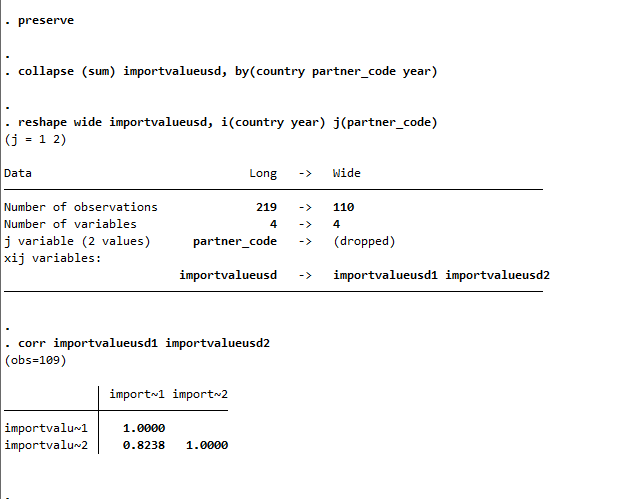 Figure 3: Pearson correlation coefficient (r) test results
Appendix 3
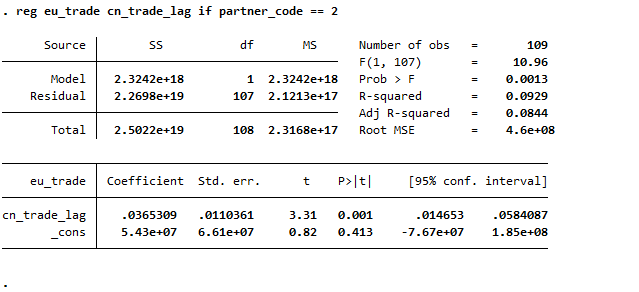 Figure 4: Linear regression results
References
Abels, J. and H.-J. Bieling (2024), ‘The geoeconomics of infrastructures: Viewing globalization and global rivalry through a lens of infrastructural competition’, Globalizations, 21 (4), 722–39.
AidData (2023), Global Chinese Development Finance Dataset, Version 2.0, available at https://china.aiddata.org/, accessed 29 September 2026.
Bhaskar, R. (2013), A Realist Theory of Science, London: Routledge (originally published by Leeds Books in 1975).
Bhuiyan, M. S. and W. Yi (2024), ‘The Belt and Road Initiative (BRI) narratives: A comparative critical analysis’, China and WTO Review, 10 (1), 46–61.
Bryman, A. (2016), Social Research Methods, 5th edn, Oxford: Oxford University Press
Christou, A. and C. Damro (2024), ‘Frames and issue linkage: EU trade policy in the geoeconomic turn’, JCMS: Journal of Common Market Studies, 62 (4), 1080–96.
Clinci, C. (2022), ‘Global Gateway vs. Belt and Road Initiative: Towards stronger or weaker global governance?’, EU Centre of Excellence, Korea University, Working Paper #19.
Creswell, J. W. (2003), Research Design: Qualitative, Quantitative, and Mixed Methods Approaches, 2nd edn, Thousand Oaks, CA: Sage.
Cui, J. (2023), ‘BRI: A path towards common development and a blueprint for China–Nigeria cooperation’, Embassy of the People’s Republic of China in Nigeria, 27 October 2023, available at http://ng.china-embassy.gov.cn/eng/zngx/cne/202310/t20231027_11169250.htm, accessed 29 September 2026.
Cummings, S., L. de Haan and A.-A. Seferiadis (2020), ‘How to use critical discourse analysis for policy analysis: A guideline for policymakers and other professionals’, Knowledge Management for Development Journal, 15 (1), 99–108.
da Silva, F. B. (2024), ‘The European Union’s role in a changing international order: The Global Gateway initiative’, População e Sociedade, 42, 57–76.
Directorate-General for Communication (2021a), ‘Global Gateway: Up to €300 billion for the European Union’s strategy to boost sustainable links around the world’, press release IP/21/6433, Brussels: European Commission, available at https://ec.europa.eu/commission/presscorner/detail/en/ip_21_6433, accessed 29 September 2026.
Directorate-General for Communication (2021b), ‘Factsheet: Global Gateway’, Brussels: European Commission, available at https://commission.europa.eu/document/3378e8f6-9d65-4ca0-8ab6-ce81399d5db6_en, accessed 29 September 2026.
Directorate-General for Communication (2021c), ‘Questions and answers on Global Gateway’, QANDA/21/6434, Brussels: European Commission, available at https://ec.europa.eu/commission/presscorner/detail/en/qanda_21_6434, accessed 29 September 2026.
Directorate-General for International Partnerships (2025), ‘Global Gateway: EU–Africa flagship projects’, Brussels: European Commission, available at https://international-partnerships.ec.europa.eu/publications-library/global-gateway-flagship-projects-infographics_en, accessed 29 September 2026
Dollar, D. and A. Kraay (2004), ‘Trade, growth, and poverty’, The Economic Journal, 114 (493), F22–F49.
Esteban, M., U. Armanini, I. Urbasos Arbeloa, R. Jorge Ricart, L. Lázaro Touza, M. S. O’Shea and I. Olivié (2023), Development Aid and Geopolitics: The EU’s Global Gateway Initiative, Policy Paper, Madrid: Real Instituto Elcano, available at https://www.realinstitutoelcano.org/en/policy-paper/development-aid-and-geopolitics-the-eus-global-gateway-initiative/, accessed 29 September 2026.
European Commission and High Representative of the Union for Foreign Affairs and Security Policy (2021), The Global Gateway, JOIN(2021) 30 final, Brussels: European Commission, available at https://eur-lex.europa.eu/legal-content/EN/TXT/?uri=CELEX:52021JC0030, accessed 29 September 2026.
Fairclough, N. (2001), Language and Power, 2nd edn, Harlow: Longman.
Furness, M. and N. Keijzer (2022), Europe’s Global Gateway: A New Geostrategic Framework for Development Policy?, Briefing Paper 1/2022, Bonn: German Development Institute (DIE), https://doi.org/10.23661/bp1.2022
Ganchev, I. (2024), China and the BRI Ten Years On: Geopolitics and Development, Regional Policy Insights, Centre for Regional Integration, https://doi.org/10.6084/m9.figshare.27176148
Gordon, D. F., H. Tong and T. Anderson (2020), Beyond the Myths – Towards a Realistic Assessment of China’s Belt and Road Initiative: The Security Dimension, London: International Institute for Strategic Studies.
Guba, E. G. and Y. S. Lincoln (1994), ‘Competing paradigms in qualitative research’, in Denzin, N. K. and Y. S. Lincoln (eds), Handbook of Qualitative Research, Thousand Oaks, CA: Sage, pp. 105–17.
Heldt, E. C. (2023), ‘Europe’s Global Gateway: A new instrument of geopolitics’, Politics and Governance, 11 (4), 223–34.
Heritage, J. (2013), Garfinkel and Ethnomethodology, Hoboken, NJ: John Wiley & Sons (originally published by Polity in 1984).
Hu, H. (2026), ‘Constructing connectivity and competing orders: Strategic narratives in the EU’s Global Gateway and China’s Belt and Road Initiative’, Comparative European Politics, 24 (1), 1–29.
Jones, L. and S. Hameiri (2020), Debunking the Myth of ‘Debt-Trap Diplomacy’: How Recipient Countries Shape China’s Belt and Road Initiative, Research Paper, London: Chatham House.
Kareem, O. I. (2010), ‘Trade agreements and exports: A case of Africa–China and the European Union trade relations’, unpublished working paper, Ibadan: Department of Economics, University of Ibadan.
Karjalainen, T. (2023), ‘European norms trap? EU connectivity policies and the case of the Global Gateway’, East Asia, 40 (3), 293–316.
Keijzer, N. (2024), ‘The southernization of the EU’s development policy? A critical review of the EU Global Gateway’, in Klingebiel, S., T. Kalinowski and N. Keijzer (eds), Emerging Trends in International Development and Climate Policy: A Focus on Korea and Germany, Cham: Springer, pp. 85–95.
Keuleers, F. (2021), ‘Choosing the better devil: Reception of EU and Chinese narratives on development by South African university students’, in Miskimmon, A., B. O’Loughlin and J. Zeng (eds), One Belt, One Road, One Story? Towards an EU–China Strategic Narrative, Cham: Palgrave Macmillan, pp. 167–93.
Kliem, F. (2021), ‘Europe’s Global Gateway: Complementing or competing with BRI?’, The Diplomat, December 2021, available at https://thediplomat.com/2021/12/europes-global-gateway-complementing-or-competing-with-bri/, accessed 29 September 2026.
Li, V. (2020), ‘Globalorientalization: Globalization through the lens of Edward Said’s Orientalism’, ariel: A Review of International English Literature, 51 (1), 3–30.
Miskimmon, A. and B. O’Loughlin (2021), ‘The EU’s struggle for a strategic narrative on China’, in Miskimmon, A., B. O’Loughlin and J. Zeng (eds), One Belt, One Road, One Story? Towards an EU–China Strategic Narrative, Cham: Palgrave Macmillan, pp. 19–43.
Miskimmon, A., B. O’Loughlin and L. Roselle (2013), Strategic Narratives: Communication Power and the New World Order, New York: Routledge.
Miskimmon, A., B. O’Loughlin and J. Zeng (eds) (2021), One Belt, One Road, One Story? Towards an EU–China Strategic Narrative, Cham: Palgrave Macmillan.
Montesano Montessori, N. (2023), ‘Critical policy discourse analysis’, in Handford, M. and J. P. Gee (eds), The Routledge Handbook of Discourse Analysis, 2nd edn, London: Routledge, pp. 610–24.
Mukumbang, F. C. (2023), ‘Retroductive theorizing: A contribution of critical realism to mixed methods research’, Journal of Mixed Methods Research, 17 (1), 93–114.
Nowak, W. (2016), ‘The European Union’s trade with Africa and Latin America’, in Spring Nature Link, Country Experiences in Economic Development, Management and Entrepreneurship, Varaždin: Varaždin Development and Entrepreneurship Agency (VADEA), pp. 689–96.
Okano-Heijmans, M. (2024), ‘The EU’s connectivity strategy 2.0: Global Gateway in the Indo-Pacific’, in Hosoya, Y. and H. Kundnani (eds), The Transformation of the Liberal International Order: Evolutions and Limitations, Singapore: Springer Nature, pp. 23–53.
Said, E. W. (1978), Orientalism, New York: Pantheon Books.
Swain, A., C. Bruch, T. Ide, P. Lujala, R. A. Matthew, E. Weinthal and T. Deligiannis (2025), ‘The U.S. withdrawal from the Paris Agreement – Implications for global climate governance and security’, Environment and Security, 3 (1), 3–7.
Tagliapietra, S. (2024), ‘The European Union’s Global Gateway: An institutional and economic overview’, The World Economy, 47 (4), 1326–35.
Tarrósy, I. (2020), ‘China’s Belt and Road Initiative in Africa, debt risk and new dependency: The case of Ethiopia’, African Studies Quarterly, 19 (3–4), 8–28.
Taylor, I. and T. Zajontz (2020), ‘In a fix: Africa’s place in the Belt and Road Initiative and the reproduction of dependency’, South African Journal of International Affairs, 27 (3), 277–95.
UNCTAD (2023), World Investment Report 2023: Investing in Sustainable Energy for All, Geneva: United Nations, available at https://unctad.org/publication/world-investment-report-2023, accessed 29 September 2026.
United Nations (2024), UN Comtrade Database, available at https://comtrade.un.org/, accessed 29 September 2026.
van Dijk, T. A. (2001), ‘Critical discourse analysis’, in Schiffrin, D., D. Tannen and H. E. Hamilton (eds), The Handbook of Discourse Analysis, Oxford: Blackwell, pp. 352–71.
von der Leyen, U. (2021), ‘State of the Union address 2021’, Strasbourg, 15 September 2021, available at https://state-of-the-union.ec.europa.eu/system/files/2022-12/soteu_2021_address_en.pdf, accessed 29 September 2026.
Wolf, A. and E. Poli (2024), ‘The trade potential of infrastructure partnerships: The case of EU Global Gateway’, Central European Economic Journal, 11 (58), 380–405.
World Resources Institute (2021), ‘Statement: China releases new climate commitment ahead of COP26’, available at https://www.wri.org/news/statement-china-releases-new-climate-commitment-ahead-cop26, accessed 29 September 2026.
Glossary
Belt and Road Initiative (BRI): A global infrastructure development strategy by the Chinese government to invest in nearly 150 countries.
Contrapuntal cosmopolitanism: A concept emphasising a humanism that resists fixed categories and embraces openness to difference.
COP26: Countries that are part of the United Nations Convention on Climate Change (UNFCCC), participated in the 26th Conference of the Parties to negotiate global climate action and create goals aimed at promoting sustainable life on earth.
Critical discourse analysis (CDA): An approach that examines how language constructs and reinforces social and power relations.
European Union Global Gateway (EUGG): An EU initiative launched in 2021 to fund global infrastructure projects in sectors like digital, climate and transport.
Multiannual Financial Framework (MFF): The European Union’s long-term budget plan, typically spanning seven years.
Normative power: An international actor’s ability to shape global norms and promote its values through non-coercive influence.
Pearson Correlation Coefficient (r): A statistical measure showing the linear relationship between two variables, ranging from -1 (negative) to +1 (positive).
Retroductive logic: A method of reasoning that infers underlying structures from observed patterns, often used in critical realism.
Strategic Narrative theory: An international relations theory developed Miskimmon et al. (2013), proposing that international actors construct their own narratives through different means (e.g. discourse, policy, dialogue), which shapes their identity and defines their outlook, in turn justifying action (or lack thereof).
To cite this paper please use the following details: Uribe, S.D. (2026), 'Navigating the Global Order through Trade and Discourse: EU’s Global Gateway and China’s Belt and Road Initiative in Africa',
Reinvention: an International Journal of Undergraduate Research, Volume 19, Issue 2,
https://reinventionjournal.org/index.php/reinvention/article/view/1969. Date accessed [insert date].
If you cite this article or use it in any teaching or other related activities, please let us know by emailing us at
Reinventionjournal@warwick.ac.uk.